
In the vast tapestry of Hindu cosmology, Lord Shiva occupies a central and paradoxical position as the deity embodying both creation and destruction. Known as Mahadeva, the Great God, Shiva is revered not merely as a destroyer but as the dynamic force that sustains the eternal cycles of the universe. His dual role in Srishti (creation) and saṃhara (destruction) reflects the profound truth that these processes are inseparable, interdependent aspects of cosmic existence. Without destruction, creation would stagnate; without creation, destruction would lack purpose.
This introductory exploration focuses on Shiva’s active engagement in the ongoing cycles of the manifest universe, drawing from scriptural traditions, iconographic representations, and philosophical interpretations to illuminate his transformative essence as the eternal orchestrator of cosmic rhythm.
Article Structure
Shiva Within the Trimurti: Beyond Mere Destruction
Hindu tradition conceptualises the divine functions through the Trimurti, Brahma the Creator, Vishnu the Preserver, and Shiva the Destroyer. This triadic framework, prominent in texts such as the Puranas, assigns distinct roles to maintain cosmic order (ṛta). While Brahma emanates the universe, Vishnu sustains it through avatars and preservation, and Shiva concludes cycles through dissolution. However, Shiva’s designation as “Destroyer” often leads to misunderstanding, for his destruction is not annihilation but regeneration, a clearing of the old to enable the emergence of the new.
As articulated in the Shiva Purana and Linga Purana, Shiva’s actions are rooted in compassion, removing obsolete structures to facilitate perpetual evolution. In broader Hindu thought, particularly within Vaishnava and Smarta traditions, Shiva’s destructive aspect harmoniously complements the creative and preservative functions. Yet, in Shaivism, the rich devotional and philosophical tradition centred on Shiva as the supreme deity, he transcends these compartmentalised roles. Shaiva Agamas and texts like the Tirumantiram of Tirumular portray Shiva as the ultimate reality (Parabrahman) who performs all cosmic functions singly, without delegation.
This elevation underscores Shiva’s dynamic involvement: he is not a passive observer but the active principle driving the universe’s pulsation.
The Cosmic Dance: Nataraja and the Rhythm of Existence
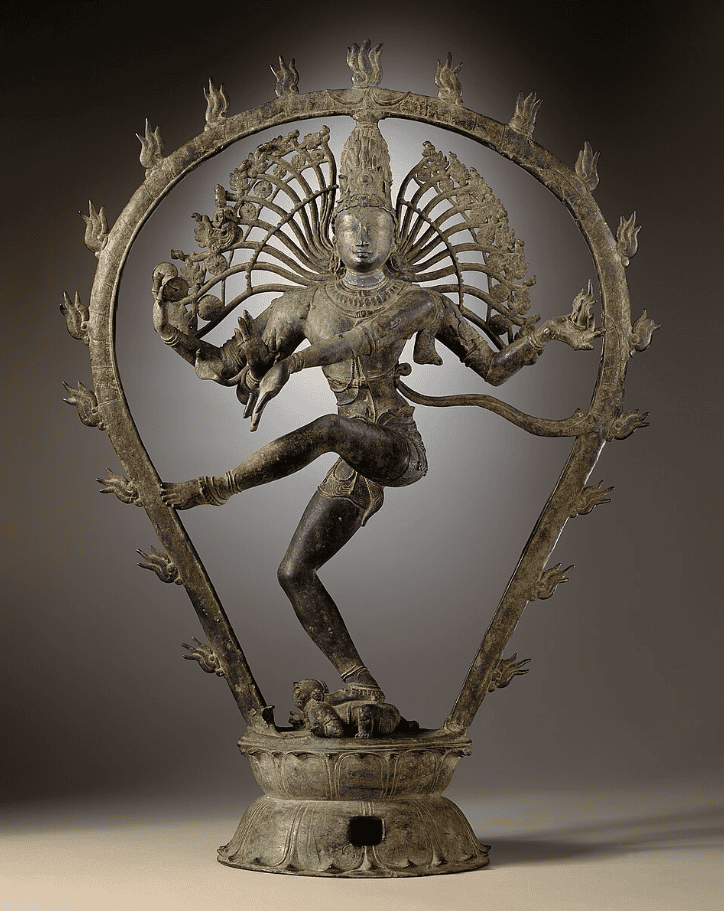
The most vivid and profound representation of Shiva’s dual role is his manifestation as Nataraja, the Lord of Dance. This iconic form, masterfully captured in Chola bronze sculptures from medieval South India (circa 10th-12th centuries CE), depicts Shiva engaged in the Ananda Tandava, the dance of supreme bliss, encircled by a ring of flames symbolising the boundless cosmos.
Each element of the Nataraja iconography conveys layers of meaning related to creation and destruction:
- The damaru (small hourglass-shaped drum) in his upper right hand produces the primal vibration (nāda) that initiates sṛṣṭi, echoing the cosmic sound Om from which the universe emanates.
- The abhaya mudra (gesture of fearlessness) in his lower right hand assures preservation and protection amidst change.
- The flame of fire in his upper left hand embodies saṃhāra, the purifying conflagration that consumes the universe at the end of a cosmic cycle (kalpa).
- The left leg raised in graceful poise signifies liberation (moksha), while the right foot crushes the dwarf demon Apasmara (representing ignorance and forgetfulness).
This multifaceted dance is meticulously balanced, illustrating that creation, preservation, and destruction occur simultaneously and harmoniously within the cosmic order. Shaiva texts describe the Tandava as encompassing the panchakritya (five acts): creation, preservation, destruction, concealment (tirodhana), and bestowal of grace (anugraha). In its fiercer form, known as the Rudra Tandava, the dance heralds universal dissolution in flames, yet this fire is ultimately purifying, preparing the ground for renewed manifestation.
The Nataraja symbolism extends to scientific analogies in modern interpretations, where the cosmic dance parallels the rhythmic expansion and contraction of the universe, akin to concepts in contemporary cosmology.
Shaiva Perspectives: Shiva as the Sole Performer of Cosmic Acts
In advanced Shaiva schools such as Shaiva Siddhanta (dualistic) and Kashmir Shaivism (non-dualistic, as expounded by Abhinavagupta in the Tantraloka), Shiva is recognised as the sole executor of the panchakritya:
- Srishti: The emanation or projection of the universe from his inherent power (Shakti).
- Sthiti: The sustenance and maintenance of creation.
- Saṃhara: The withdrawal or dissolution back into himself.
- Tirodhana: The veiling of his true nature, enabling bound souls (paśu) to experience duality and karma.
- Anugraha: The conferring of grace, revealing ultimate reality and granting liberation.
These five acts highlight Shiva’s comprehensive engagement with the manifest world. In contrast to the Trimurti’s apparent division, Shaiva philosophy asserts that Shiva subsumes Brahma and Vishnu: he projects himself as Brahma for creation and as Vishnu for preservation, while inherently retaining the power of transformative destruction.
Complementing this is the Ardhanarishvara form, Shiva as half-male, half-female, symbolising the indivisible union of Shiva (pure consciousness) and Shakti (dynamic energy). From this primal unity arises creation; into it dissolves destruction, emphasising that polarity is resolved in the divine whole.
The Linga: Eternal Symbol of Creative and Destructive Potential
At the heart of Shiva worship lies the Shiva Linga, an abstract, aniconic symbol representing infinite creative and destructive potential. The linga, often paired with the yoni (base representing Shakti), signifies the cosmic pillar from which all emerges and to which all returns.
This is vividly illustrated in the Lingodbhava myth from the Puranas: to settle a dispute between Brahma and Vishnu over supremacy, Shiva manifests as an immeasurable pillar of light (jyotirlinga). Neither deity can find its ends, affirming Shiva’s boundless primacy and his role as the source beyond creation.
The linga’s form, cylindrical and upward-pointing, embodies generative force, while its absorptive quality reflects dissolution. Temples housing ancient svayambhu (self-manifested) lingas, such as those at Kedarnath or Varanasi, serve as focal points for contemplating these dual energies.
Destruction as Transformation and Liberation
Shiva’s destructive aspect is frequently misconstrued as fearsome or malevolent, yet Shaiva philosophy reveals it as profoundly benevolent. Saṃhara eradicates impurity, ego (ahamkara), and stagnation, fostering spiritual growth and renewal. As the supreme yogi, often depicted in meditative repose atop Mount Kailash, Shiva exemplifies detachment within intense activity, teaching that liberation arises from recognising the impermanence of the phenomenal world (maya).
The cyclical nature of kalpas (aeons) underscores this: Shiva’s cosmic dance draws the universe from void (shunya), sustains it in equilibrium, and withdraws it in dissolution, only for the cycle to recommence eternally. This mirrors observable natural processes: the seasons’ renewal, the life-death-rebirth continuum, and diurnal rhythms.
On a personal level, Shiva’s role inspires transformative sadhana (spiritual practice). Devotees chant mantras like Om Namah Shivaya or perform rituals to invoke his grace in destroying inner impediments, ignorance (avidya), desire, and illusion, thus paving the path to self-realisation and union with the divine.
In non-dual Shaivism, this extends to the recognition that the individual self (jiva) is none other than Shiva, and cosmic cycles are mere play (lila) of consciousness.
Conclusion: Shiva as the Dynamic Heart of the Universe
Lord Shiva, the Eternal Source of Creation and Destruction, embodies the profound interconnectedness of opposites within the manifest universe. His active dual role, sparking existence through primordial vibration and consummating it through transformative fire, maintains cosmic balance, renewal, and evolution. Far from a figure of mere termination, Shiva emerges as the compassionate orchestrator of change, whose dance sustains the eternal flux of reality.
Through enduring icons like Nataraja, Ardhanarishvara, and the Linga, as well as the philosophical profundity of Shaiva traditions, Shiva reveals himself as Mahadeva: auspicious, transcendent, and immanent. This exploration lays the foundation for deeper inquiries into his unchanging essence beyond these cycles.