
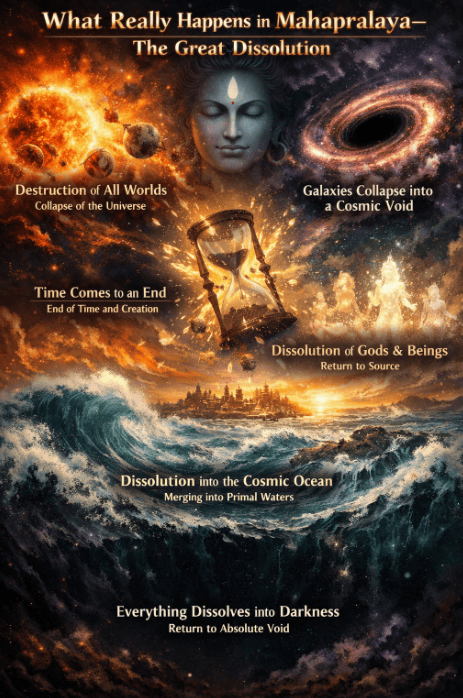
In the intricate framework of Hindu cosmology, Mahapralaya, commonly rendered as the Great Dissolution, constitutes the comprehensive and cyclical reabsorption of the entire manifested universe into its primordial, unmanifest origin. This phenomenon stands apart from lesser forms of dissolution (pralaya) that transpire at the conclusion of each cosmic day (kalpa) or era, as it signifies the absolute termination of a Mahākalpa, the complete lifespan of Brahma, the deity responsible for creation. Encompassing the retraction of all existent entities, from elemental constituents to divine beings and individual souls, Mahapralaya restores the cosmos to a condition of undifferentiated equilibrium. The ensuing analysis meticulously outlines the precise mechanisms, sequential stages, and far-reaching ramifications of Mahapralaya, with a particular emphasis on the intricacies of its total absorptive process. This examination is informed by venerable scriptural authorities, including the Puranas, the Bhagavata Purana, the Vishnu Purana, and supplementary texts from Shaiva and Vaishnava traditions, providing a structured elucidation of this profound cosmic event.
The concept of Mahapralaya is deeply embedded in the Vedic understanding of time and existence, where the universe is perceived not as a static entity but as a pulsating manifestation emanating from and returning to the absolute. Ancient sages, through meditative insights, described this process as an eternal rhythm, akin to the inhalation and exhalation of the divine. For instance, the Rig Veda hints at such cycles in hymns praising the cosmic order (ṛta), while later Upanishads and Puranas elaborate on the mechanics. In this context, Mahapralaya serves as the grand counterpoint to creation (sṛṣṭi), ensuring that the universe does not persist indefinitely in a state of entropy but is periodically renewed through dissolution and subsequent reformation.
Article Structure
Distinctions Between Types of Pralaya
To fully grasp the singularity of Mahapralaya, one must differentiate it from other categories of pralaya, each representing varying scales of dissolution within the hierarchical structure of Hindu time cycles. These distinctions are crucial, as they highlight the escalating magnitude from personal to universal levels.
- Nitya Pralaya (Daily Dissolution): This occurs routinely in the lives of individual beings, manifesting as deep sleep (suṣupti) or physical death. During sleep, sensory perceptions and mental activities are temporarily absorbed into the subconscious, allowing for rest and rejuvenation. In death, the gross body dissolves, while the subtle body carries forward karmic impressions. The Chandogya Upanishad illustrates this as a microcosmic reflection of larger cosmic processes, where the individual soul experiences a brief merger with the universal.
- Naimittika Pralaya (Occasional Dissolution): Also known as Brahma’s night, this takes place at the end of each kalpa, equivalent to one day in Brahma’s life (roughly 4.32 billion human years). Here, the lower three realms, Bhūḥ (earth), Bhuvaḥ (atmosphere), and Svaḥ (heaven), are inundated by catastrophic floods and consumed by fire, as narrated in the Vishnu Purana. The higher realms remain intact, and souls migrate to subtler planes. This pralaya is triggered by Brahma’s repose, symbolizing a partial reset of the cosmic order.
- Prākṛtika Pralaya (Elemental Dissolution): Occurring at the conclusion of Brahma’s full lifespan (100 Brahma years), this involves the disintegration of all elemental and subtle components across the higher worlds as well. It closely parallels Mahapralaya in scope but is sometimes distinguished by its focus on the dissolution of prakṛti’s (nature’s) constituents without immediate reference to the supreme absorption.
- Ātyantika Pralaya (Ultimate Dissolution): This is not a cosmic event but an individual achievement of liberation (moksha), where the soul transcends all cyclical existence, merging eternally with the absolute. As expounded in Advaita Vedanta by Adi Shankara, it represents the dissolution of ignorance (avidya), rendering the individual immune to rebirth.
Mahapralaya, often synonymous with Prākṛtika Pralaya in broader contexts, embodies the most expansive scale, entailing the reabsorption of the entire cosmos, inclusive of Brahma, into the supreme reality (Parabrahman). Unlike the others, it eradicates all distinctions, leaving no residual manifestation.
The Stages and Mechanics of Mahapralaya
The orchestration of Mahapralaya proceeds through meticulously ordered stages, inverting the sequence of cosmic emanation (sṛṣṭi) as delineated in Sankhya philosophy. Scriptural accounts, such as those in the Bhagavata Purana (Canto 12) and Vishnu Purana, portray this as a gradual escalation toward unity, governed by divine will.
- Preceding Signs and Duration: Mahapralaya ensues after Brahma’s 100-year tenure, spanning an astronomical 311.04 trillion human years. Omens herald its approach, including moral degeneration (adharma), environmental upheavals like droughts and earthquakes, and the erosion of societal structures. These signs, detailed in the Markandeya Purana, serve as warnings of impending cosmic renewal.
- Dissolution of Gross Elements: Commencing with the material plane, earth (pṛthvī) merges into water through global inundations, submerging continents. Water then evaporates into fire (tejas), igniting universal conflagrations. Fire dissipates into air (vāyu), dispersed by cosmic gales, which in turn dissolve into ether (ākāśa), the substratum of sound and space. Ether finally integrates into the subtle sense potentials (tanmātras), as per the sequential reversal in the Mahabharata’s Shanti Parva.
- Absorption of Subtle Principles: Progressing inward, the cosmic intellect (mahat-tattva) subsumes the ego principle (ahaṅkāra), followed by the five tanmātras (sound, touch, form, taste, smell) folding into unmanifest prakṛti. Prakṛti achieves perfect equilibrium (sāmyāvasthā), withdrawing into the unmanifest (avyakta), under the influence of time (kāla) as an instrument of the divine.
- Involvement of Deities: As the process intensifies, lesser deities like Indra (thunder) and Agni (fire) are absorbed early. Brahma, having fulfilled his creative mandate, integrates into Vishnu’s navel or directly into the absolute. Vaishnava narratives depict Vishnu assuming yoga-nidra (yogic slumber) upon the serpent Ananta Śeṣa in the causal ocean (kāraṇa-samudra), preserving the cosmic seed. In Shaiva traditions, Shiva enacts the ferocious Rudra Tandava, a dance of annihilation that engulfs the universe in purifying flames, as vivid in the Shiva Purana.
Within Kashmir Shaivism, as articulated by Abhinavagupta in the Tantraloka, Shiva assimilates all phenomena into his boundless consciousness, persisting as the immutable core.
State During Non-Manifestation: In this phase, the universe resides latently within Parabrahman, comparable to a banyan tree encapsulated in its seed (Brihadaranyaka Upanishad analogy). Temporal constructs dissolve, yielding to timelessness, with only the absolute prevailing in undifferentiated bliss.
These stages underscore the methodical nature of dissolution, ensuring no chaotic remnants.
What Occurs to the Universe, Deities, and Beings
The ramifications of Mahapralaya extend to every facet of existence, facilitating a complete reset.
- The Universe: All physical and subtle structures vanish. The tri-loka (three worlds), the fourteen bhuvanas (planetary levels), and infinite galaxies revert to prakṛti’s unmanifest form, shrouded by maya (illusion). This absorption erases spatial and temporal distinctions, as per the Linga Purana.
- Deities: Hierarchical dissolution sees minor devas (e.g., Varuna for water) integrate first. Brahma assimilates into Vishnu’s subtle essence or the absolute. Vishnu, in certain depictions, sustains as the dormant preserver, poised to emanate new creations from his breath. Shiva, embodying transcendence, remains unaltered, serving as the eternal observer and agent of renewal.
- Beings and Souls: Jivas (embodied souls) enter laya (suspended state), akin to deep slumber without awareness. Moksha-attained souls abide eternally liberated. Karmically bound souls preserve saṃskāras (impressions) and residual karma in subtle form, primed for reincarnation in ensuing cycles. This process is painless, with consciousness retracting into ananda (bliss), as emphasized in Vedantic texts.
Shaiva and Vaishnava Perspectives on Mahapralaya
Interpretations diverge across sects, enriching the conceptual landscape.
- Vaishnava Perspective (Bhagavata Purana): Vishnu, as Narayana, reclines on Śeṣa amid causal waters, embodying the conservation of potentiality. Mahapralaya thus represents his restorative slumber, from which new universes burgeon forth.
- Shaiva Perspective (Shiva Purana, Linga Purana): Shiva orchestrates dissolution via saṃhāra, yet his immutability persists. The cosmos converges into the Shiva Linga, symbol of infinite potential, or his pure awareness.
- Non-Dual Advaita Perspective (Mandukya Upanishad): Pralaya exemplifies manifestation’s illusoriness (maya); Brahman alone endures, with cycles as apparent superimpositions.
- In Shakta traditions, the Goddess (Devi) as Mahāmaya governs the veiling and unveiling, while Smarta syntheses integrate these into a unified Brahman.
These viewpoints coalesce on the theme of cyclical renewal, where dissolution fosters regeneration.
Mahapralaya Symbolism
Symbolically, Mahapralaya is depicted through motifs like the cosmic ocean (samudra manthan inversed) or Shiva’s Tandava. Iconography includes Vishnu on Śeṣa, representing repose amid chaos, and Rudra forms of Shiva with flames, evoking purification. Temples like those at Elephanta Caves illustrate these through sculptures, aiding meditative contemplation.
Mahapralaya: Mechanics of Total Universe Dissolution
Mahapralaya profoundly illustrates anitya (impermanence), compelling detachment from material attachments and the quest for eternal truth. It parallels personal mortality and reincarnation, instructing that forms are transient vessels for the atman (self). Spiritually, meditation on pralaya cultivates vairāgya, as in Patanjali’s Yoga Sutras, and awareness of the self’s cyclicity-transcendence.
In contemporary terms, it resonates with scientific notions like the Big Crunch, offering metaphorical insights into entropy and renewal. Ultimately, it unveils the divine līlā: creation-dissolution as harmonious expressions of the eternal, with Shiva’s detachment exemplifying transcendence amid absorption.
This understanding bridges to Shiva’s immutable essence beyond cosmic vicissitudes.