
In the rich spiritual traditions of Hinduism, particularly those centred on Lord Shiva, there exists a profound concept describing his ultimate nature before the universe or anything else comes into being. This nature is known as nirguṇa, meaning completely without qualities, attributes, names, or forms. In this state, Shiva is referred to as Paramasiva, the supreme and highest reality that lies entirely beyond what we can perceive, imagine, or express in words. This is the absolute, unmanifest essence, silent, infinite, and self-existent, prior to any creation, duality, or even the initial flow of energy. Importantly, this discussion focuses solely on the pre-emanative absolute, without reference to relationships with other deities or the manifested world. The following explanation presents this idea in straightforward language, drawing from ancient scriptures and teachings to make it accessible.
Article Structure
Understanding the Meaning of Nirguṇa
The term nirguṇa originates from Sanskrit, where “nir” signifies “without” and “guṇa” refers to qualities or properties. Thus, nirguṇa Shiva possesses no definable characteristics: no shape, no colour, no size, no name, and no traits that the human mind can grasp. This contrasts sharply with saguṇa, the aspect “with qualities,” where Shiva appears in recognisable forms such as the cosmic dancer Nataraja, the meditative ascetic, or under names like Mahadeva (the great god) or Rudra (the fierce one).
In the nirguṇa state, Paramasiva transcends all pairs of opposites that define our experience. There is no distinction between good and evil, light and darkness, pleasure and pain, or even being and non-being. It is a state of absolute oneness, free from any fragmentation or division. This condition exists before any movement, change, or appearance occurs. Ancient sages emphasise that this represents the fundamental truth underlying all reality, yet it remains challenging for ordinary minds to comprehend, as our thoughts rely on names, forms, and comparisons to function.
To illustrate, consider a vast, calm sky without clouds, stars, or boundaries, pure emptiness that is full in its own way. Nirguṇa Paramasiva is similar: boundless potential without any expression.
Paramashiva as the Supreme Transcendent Reality
Paramasiva denotes this ultimate state, with “parama” meaning the highest or beyond all. Here, Shiva engages in no activity, no creation, preservation, destruction, concealment, or bestowal of grace. Even Shakti, his dynamic power often depicted as inseparable energy, is not yet distinct or active. Everything remains perfectly still, complete, and self-contained.
Shaiva scriptures portray this as pure consciousness (cit) aware only of itself, without objects, subjects, or separation. Imagine an immense ocean without a single ripple: no waves, no wind, no shore. Time does not flow, space does not extend, and change does not occur. This is the absolute reality prior to manifestation, the quiet foundation before any idea of “something” arises.
This perspective differs from descriptions of Shiva in active or relational roles. The emphasis remains exclusively on the pre-emanative absolute: the silent source untouched by potentiality or projection.
Symbolic Representations of the Formless
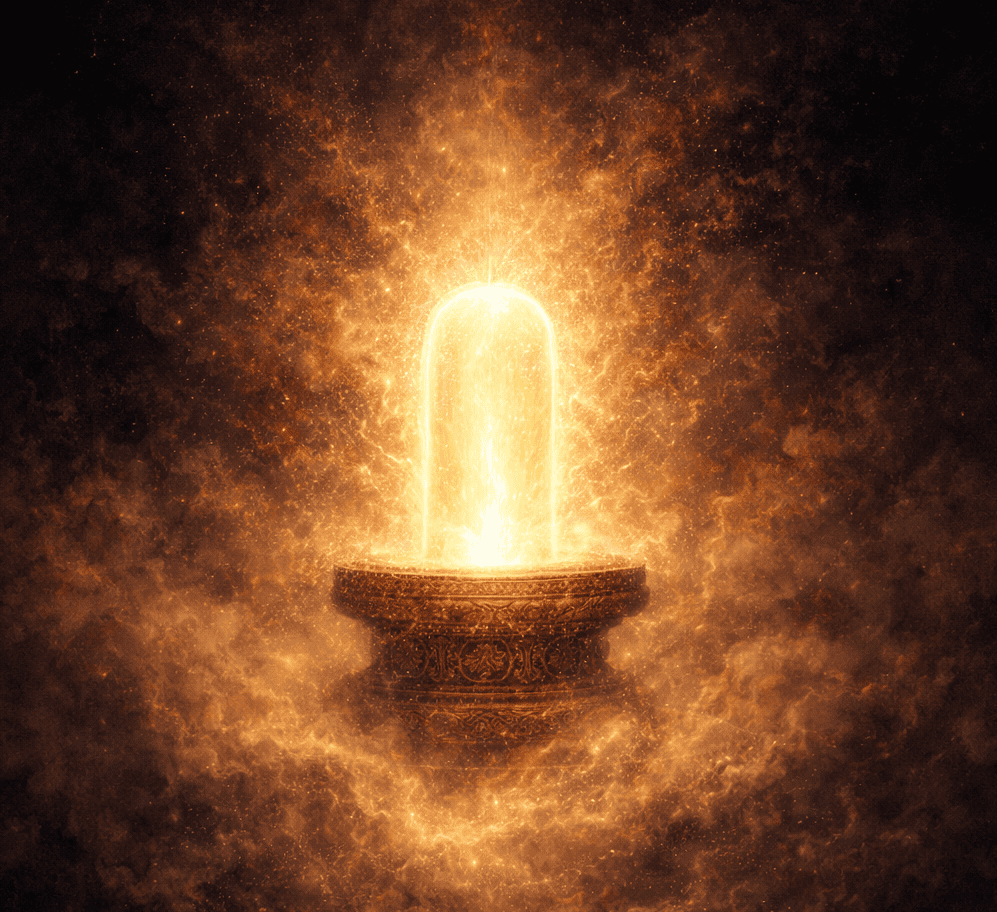
Although Paramasiva defies form, symbolic pointers aid contemplation. The Shiva Lingam serves as the primary emblem: a simple, abstract cylindrical stone without facial features, limbs, or adornments. It symbolises infinite, formless potential, eternal without beginning or end.
Devotees worship the lingam in temples as the direct representation of nirguṇa Shiva. Mythological accounts recount sages attempting to envision Shiva’s boundaries, only for him to manifest as an boundless pillar of light, demonstrating the impossibility of confining him to shape.
Another powerful symbol appears in the Chidambaram Temple in South India, where the central shrine contains no idol, merely empty space (akasa), signifying the formless absolute. This “secret of Chidambaram” invites worshippers to meditate on invisibility as the highest truth.
Other representations include the uncarved svayambhu (self-manifested) lingams emerging naturally from the earth, underscoring spontaneity without human-imposed form.
Insights from Sacred Scriptures
Numerous ancient texts elaborate on this nameless state. The svetasvatara Upanishad, one of the principal Upanishads linked to Shiva, describes the supreme reality as “without parts, without actions, tranquil, faultless, taintless, the highest bridge to immortality… formless and wonderful.”
Shaiva Agamas, esoteric ritual and philosophical texts, position Paramasiva at the pinnacle, superior even to Sadasiva, a subtle form with incipient will. Before emanation, Shiva abides in absolute repose, devoid of intention or movement.
The Shiva Purana and Linga Purana allude to this state indirectly through narratives of Shiva’s withdrawal into solitude, emphasising his self-sufficiency beyond manifestation.
Kashmir Shaivism provides detailed exposition. Masters such as Vasugupta (author of the Shiva Sutras) and Abhinavagupta (in works like the Tantraloka) characterise Paramasiva as the pure light of consciousness (prakasa) united with unimpeded freedom (svatantrya). There is no interior or exterior, no knower or known, only boundless awareness in perfect bliss (ananda). The universe emerges subsequently as an expression of this freedom, yet the origin remains pristinely formless.
The Pre-Emanative Nature: Beyond Emanation and Duality
A central aspect is the pre-emanative quality of this state. Emanation refers to the outflow or projection that initiates manifestation. Prior to this, no separate Shakti operates, no subtle principles unfold, and no worlds, beings, or dualities exist.
Duality involves perceiving reality in opposing terms: subject versus object, self versus other, unity versus multiplicity. In Paramasiva, such distinctions are absent. It is non-dual oneness, transcending even conceptual notions of “one” as opposed to “many.”
Manifestation begins when inherent power activates, leading to progressive stages of creation. However, Paramasiva endures unchanged at the heart, nameless, formless, and untouched.
Scriptures assert that the ultimate truth defies naming. Designating it “Shiva” serves merely as a convenient pointer; the essence itself surpasses language, as words depend on forms and qualities.
Pathways to Experiencing the Formless Through Practice
Spiritual traditions offer methods to glimpse this state. Advanced meditation (dhyana) guides practitioners beyond sensory input, thoughts, and mental images toward silent awareness.
Techniques include focusing on the breath until it dissolves, repeating seed sounds like “Om” to transcend vibration, or practising neti-neti (“not this, not that”) to negate all attributes.
Yogic texts describe stages where the meditator dissolves ego boundaries, entering samadhi, absorption in the formless. Teachers instruct that when mental activity ceases clinging to forms, the innate nameless Shiva shines forth.
Such realisation yields liberation (moksha), revealing the individual’s true identity as this eternal essence, beyond bodily labels or mental constructs.
Relevance in Contemporary Life
Amid modern life’s abundance of labels, digital images, and societal divisions, contemplating the nameless and formless offers profound tranquillity. It serves as a reminder that beneath surface differences lies an underlying unity and peace.
This concept bridges various Hindu schools: the nirguṇa Brahman of Advaita Vedanta aligns closely with Paramasiva, whether addressed as Shiva or otherwise.
For practitioners, devotion (bhakti) to the formless fosters intimate union, not through visualising an icon, but through sensing the infinite presence within and around.
Distinctions from Other Aspects of Shiva
The nirguṇa state stands apart from Shiva’s manifested roles or saguṇa expressions. It concerns solely the absolute prior to projection, without involving divine hierarchies or cosmic functions.
Subsequent phases introduce attributes, names such as Ishvara or Rudra, and relational dynamics, yet the transcendent core persists eternally nameless.
Conclusion: Embracing the Silent Infinite
The nameless and formless state of Paramasiva constitutes the most profound insight in Shaiva traditions. As the pre-emanative absolute, it embodies reality beyond manifestation, duality, names, or forms. Through symbols like the lingam, scriptural guidance, and meditative practice, seekers approach this serene depth.
Attaining such understanding confers lasting freedom and wholeness. This foundation naturally extends to examining siva-tattva as the philosophical core principle.