
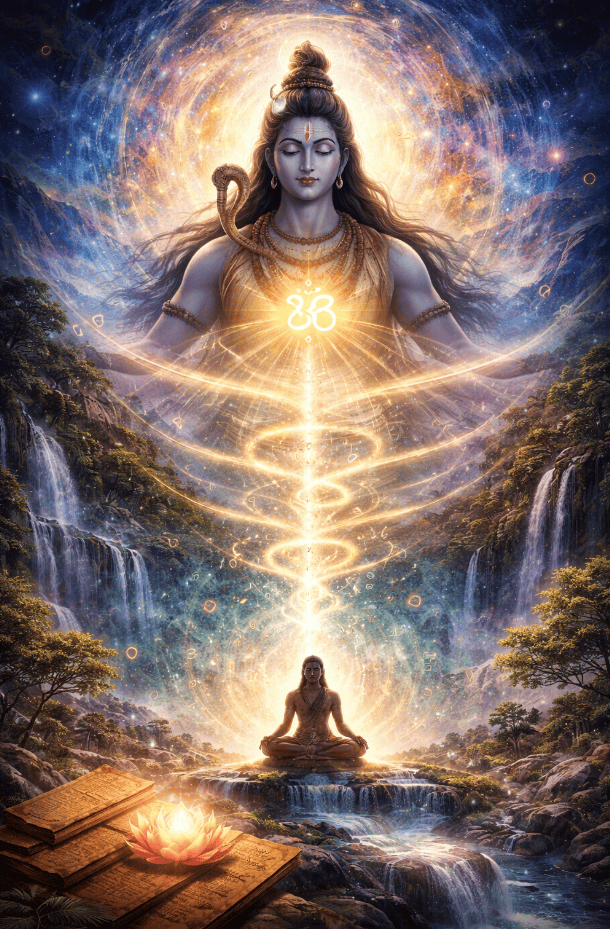
In Kashmir Shaivism, reality is understood as a living and conscious process, not a static structure. Existence does not begin as inert matter that later becomes animated. It begins as consciousness itself, known as Shiva. The universe is the self expression of this consciousness. Within this worldview lies a central insight. Long before human language developed words, grammar, and syntax, sound and meaning already existed as fundamental aspects of reality.
Sound and meaning are not created by speech in this system. They are intrinsic to consciousness. Language appears later as an outer and limited expression of something deeper. To understand this idea, one must examine key principles of Shaiva cosmology such as Spanda, Nada, and the graded levels of Vak.
Article Structure
Supreme Consciousness as Dynamic Reality
Kashmir Shaivism describes Shiva as pure consciousness that is both transcendent and present within all experience. Shiva is not separate from the world. Shiva is the ground in which all experiences arise. This consciousness possesses absolute freedom, known as svatantrya, and an inherent power of expression, known as Shakti. Shiva and Shakti are not two entities. They are two aspects of the same non dual reality.
Manifestation begins with an inner movement within consciousness itself. This movement is called Spanda. Spanda does not refer to physical vibration or motion in space. It refers to the subtle pulsation of awareness, the capacity of consciousness to experience itself. The text Spandakarika, traditionally attributed to Kallata, explains Spanda as the ever present throb through which the divine is revealed in all perception.
Through Spanda, consciousness appears as multiplicity without losing its unity. The world is therefore real. It is not an illusion or a mistake. It is a genuine manifestation of consciousness in varied forms.
Nada as the First Differentiation of Consciousness
From this pulsation arises Nada, the primordial sound. Nada is not an audible sound. It is an unstruck vibration that exists prior to physical hearing. Nada represents the first differentiation within consciousness, where potential expression begins to take form.
Shaiva texts describe Nada in relation to Bindu, the concentrated point of creative potential. Bindu contains both stillness and dynamic power. Different texts describe the sequence of Nada and Bindu in slightly different ways, but the core idea remains consistent. Nada represents the sonic principle through which manifestation unfolds.
Nada is often associated with Om, but it is not limited to any specific syllable. It is the source of all possible sounds. Drawing from earlier Indian linguistic philosophy, especially the work of Bhartrihari, Shaiva thinkers understood sound as an ontological principle. Sound in this context refers to the vibrational capacity of consciousness itself, not spoken language.
Because Nada exists before phonemes and words, it is pre linguistic. Language does not generate meaning. Meaning already exists as a mode of awareness. Language only reflects it at the surface level.
The Four Levels of Vak and the Descent of Meaning
Shaiva philosophers such as Abhinavagupta explained the relationship between consciousness and language through four levels of Vak. These levels describe how undivided awareness gradually becomes articulated speech.
Para Vak is the highest level. It is identical with pure consciousness. At this level, sound and meaning are completely unified. There is no expression, no separation, and no speaker or listener. Meaning exists as self awareness.
Pashyanti Vak is the level where differentiation begins to appear, but still as a unified vision. Sound and meaning arise together as a single intuitive whole. Understanding occurs directly, without words or sequences.
Madhyama Vak is the mental level. At this stage, meaning begins to arrange itself into thought and inner language. Speech exists internally but has not yet become audible.
Vaikhari Vak is external and articulated speech. This is the level of spoken language, grammar, and convention. Meaning here is conveyed through symbols and shared rules. Compared to the higher levels, it is the most limited expression.
In this model, meaning originates within consciousness itself. Language is its final expression, not its source.
Matrika and the Sonic Structure of Creation
Within Shaiva metaphysics, the Sanskrit alphabet is understood as Matrika, the matrix of creation. The letters are not arbitrary symbols. They are specific powers of consciousness. Each phoneme represents a particular vibrational function that participates in manifestation.
Mantra practice works directly with Matrika. A mantra does not operate like ordinary speech. It does not communicate meaning through description. Instead, it functions by resonating with pre linguistic layers of awareness. Through this resonance, the practitioner retraces the process of manifestation back toward its source.
Sound and Meaning Importance in Shaiva Thought
Kashmir Shaivism presents reality as inherently meaningful because it arises from conscious self awareness. Sound and meaning are not inventions of the human mind. They are expressions of the same consciousness that appears as the universe.
Bondage arises when awareness becomes confined to external language and conceptual divisions. Liberation occurs through Pratyabhijna, the recognition that ones own awareness is identical with Shiva, the source of all vibration and meaning.
This teaching does not reject language. It places language in its proper role. Words are tools, not foundations. Genuine understanding lies in the subtle pulsation from which words arise and into which they dissolve.
In this primordial echo, Shaiva philosophy locates both the origin of the cosmos and the path to self realization.