
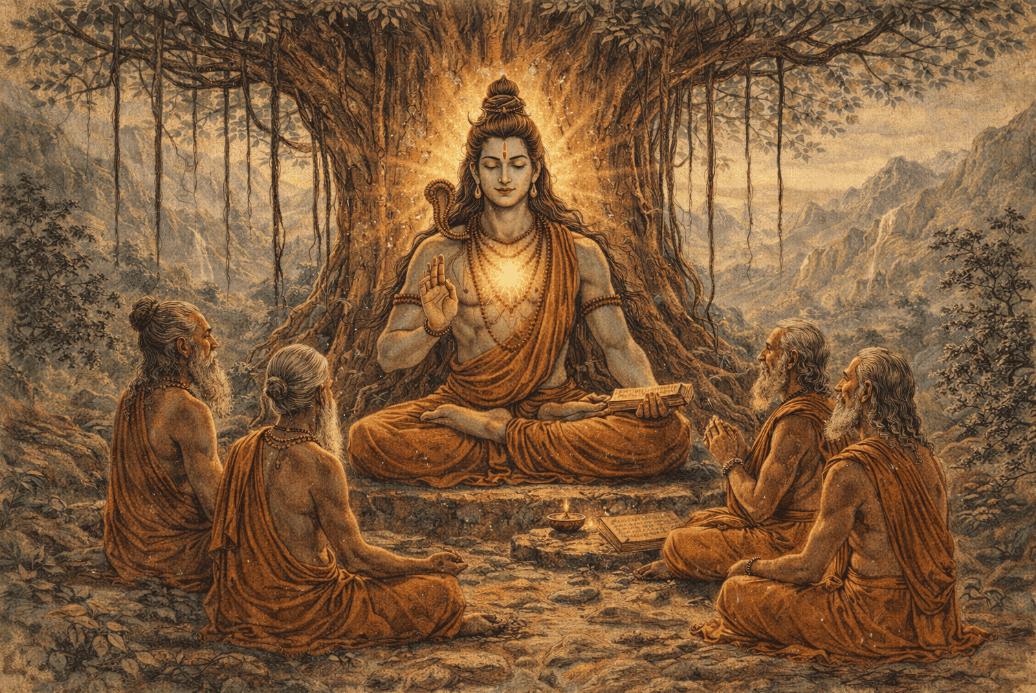
In the profound traditions of Shaivism, divine instruction often transcends the limitations of spoken language. Lord Shiva, revered as the supreme consciousness, imparts the highest knowledge not through elaborate discourses but through a silent presence that awakens the seeker directly. This form of teaching, known as mauna vyakhyana (explanation through silence), represents the pinnacle of spiritual guidance. It bypasses intellectual analysis and delivers eternal truths straight to the inner being, fostering immediate realization.
Central to this concept is Shiva’s manifestation as Dakshinamurti, the south-facing guru. In this iconic form, Shiva sits serenely under a banyan tree, facing south, surrounded by ancient sages who appear as youthful disciples despite their advanced age. His silence conveys the ultimate reality, dissolving all doubts and revealing the non-dual nature of existence.
Article Structure
Symbolism of Dakshinamurti
Dakshinamurti’s form carries deep symbolic meaning. Seated in a relaxed posture beneath the ancient banyan tree, which represents the vastness of the universe and the interconnectedness of all life, Shiva faces south, the direction associated with Yama, the lord of death. This orientation signifies the transcendence of mortality and the guidance toward immortality through knowledge.
His right hand forms the chinmudra (gesture of consciousness), where the thumb and index finger touch, symbolizing the union of the individual soul (jivatman) with the supreme soul (paramatman). The other three fingers remain extended, indicating the separation from the three gunas (sattva, rajas, tamas) or the three worlds. In some representations, he holds a drum (damaru) for cosmic rhythm, fire for destruction of illusion, and sometimes a book or rosary, yet the core teaching remains silent.
The four sages, Sanaka, Sanandana, Sanatana, and Sanatkumara, sit attentively before him. Though ancient in wisdom, they appear youthful in the presence of the eternal guru, emphasizing that true knowledge rejuvenates the spirit and transcends physical age.
The Mythological Context and Purpose of Silent Teaching
According to tradition, the creator Brahma brought forth the four Kumaras, eternally youthful sages dedicated to spiritual inquiry. Seeking ultimate knowledge, they approached Shiva. Recognizing their readiness and purity, free from ego and worldly distractions, Shiva manifested as Dakshinamurti. His silent instruction suited their elevated state, allowing them to transcend intellectual barriers and directly experience non-dual reality.
This narrative highlights a key principle: the highest teaching occurs when the disciple is prepared. Verbal explanations suit beginners, but advanced seekers receive wisdom through presence alone. Silence eliminates misinterpretation and the limitations of language, conveying truths that words can only approximate.
In Shaiva temples across South India, Dakshinamurti occupies a niche on the southern wall of the sanctum sanctorum. This placement ensures that devotees circumambulating the shrine encounter the silent guru, receiving his grace in a subtle, transformative manner.
The Nature of Wordless Transmission in Shaiva Philosophy
Shaivism teaches that ultimate truth, Shiva as pure consciousness, exists beyond duality, time, and form. Language, bound by concepts and distinctions, cannot fully capture this reality. Hence, the most effective transmission is non-verbal.
This transmission operates through para vak, the supreme speech that resides in silence. Unlike audible sound, para vak is the vibration of consciousness itself, perceived inwardly. When the mind quiets, this inner resonance awakens self-knowledge, revealing the identity between the self and the divine.
In this process, the guru’s presence acts as a catalyst. The disciple, in receptive stillness, experiences a direct infusion of awareness. Doubts dissolve naturally, not through argument, but through recognition of the eternal truth already present within.
This approach aligns with the guru-shishya tradition, where the teacher’s silent gaze or mere proximity transmits knowledge heart to heart. It emphasizes surrender, humility, and inner readiness over intellectual effort.
The Path to Receiving Silent Wisdom Today
For contemporary seekers, engaging with this silent transmission requires cultivating inner quietude. Practices include:
- Meditation in stillness: Sit quietly, focusing on the breath or the space between thoughts, inviting the presence of the inner guru.
- Contemplation of Dakshinamurti: Visualize the form or study temple images, allowing the symbolism to quiet the mind.
- Surrender and receptivity: Approach spiritual practice without expectation, trusting that truth reveals itself in silence.
- Daily reflection: Observe moments of intuitive insight that arise without verbal reasoning, recognizing them as echoes of divine transmission.
Such practices lead to profound meditative insight. Over time, the practitioner experiences flashes of direct enlightenment, moments where separation from the divine vanishes, replaced by boundless awareness.
This path demands patience and consistency. Unlike active methods, it unfolds gradually, yet its effects are permanent, rooting the individual in eternal truth.
The Universal Relevance of Shiva’s Silent Teaching
Shiva’s wordless transmission addresses a timeless human need: to know reality beyond concepts. In an era filled with information and discourse, this approach reminds us that true wisdom often lies in what remains unsaid.
Dakshinamurti embodies compassion in its purest form, guiding without imposition, illuminating without force. The silent guru invites every seeker to turn inward, where eternal truths await discovery.
By contemplating this form and embracing silence, one aligns with the supreme consciousness. In that alignment lies liberation: the recognition that one has always been Shiva, the source of all.
This profound meditative insight offers a direct route to enlightenment. It is accessible to all who approach with sincerity, proving that the deepest teachings require no words, only an open heart and a still mind.