
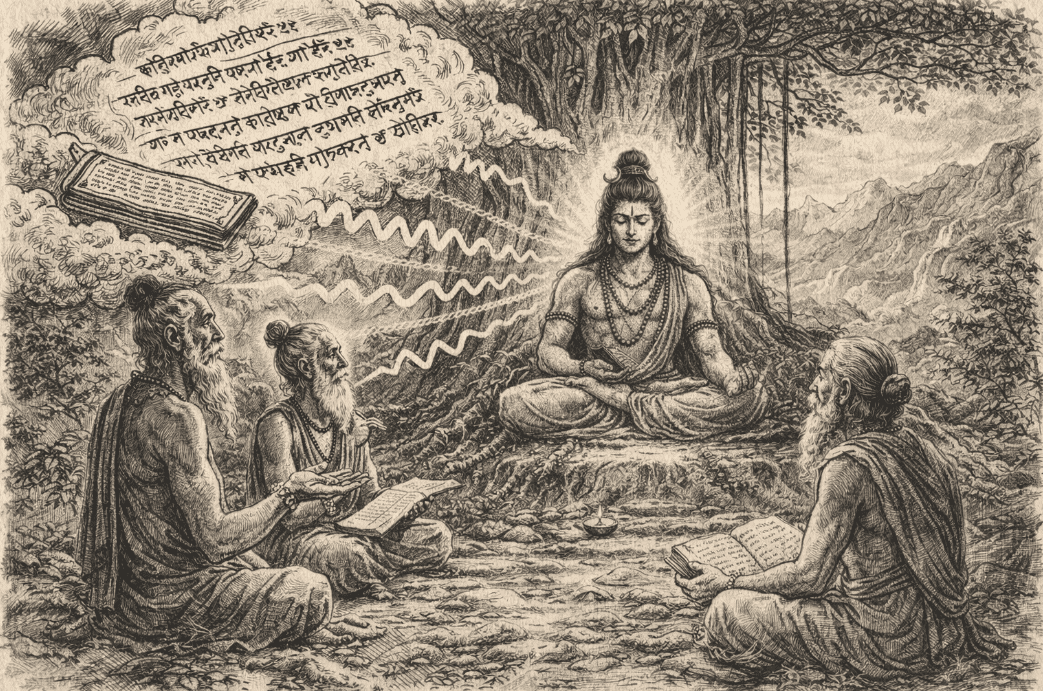
The Vedas stand as the oldest sacred texts in human history, forming the foundational scriptures of Hinduism. Composed in an ancient form of Sanskrit, these texts include hymns, rituals, philosophical inquiries, and cosmic insights that have guided spiritual thought for millennia. What sets the Vedas apart from most religious scriptures is their unique classification as Shruti, meaning “that which is heard.” This designation raises a profound and enduring question: Were the Vedas composed by human authors, or were they revealed as eternal truths received through divine audition?
This debate, heard versus composed, presents a timeless enigma. It invites reflection on the nature of revelation, the source of sacred knowledge, and the transcendental origin of scripture. In Hindu tradition, the Vedas are described as apaurusheya, authorless and eternal, existing beyond time and human creation. This perspective challenges conventional ideas of authorship and positions the Vedas as primordial echoes of cosmic reality.
Article Structure
The Concept of Shruti: Knowledge That Is Heard
The term Shruti derives from the Sanskrit root “shru,” meaning “to hear.” In contrast to Smriti (that which is remembered), which includes later texts composed by human minds, Shruti refers to the four Vedas, Rigveda, Yajurveda, Samaveda, and Atharvaveda, as direct auditory revelations.
Ancient tradition holds that highly realized sages, known as rishis, entered deep meditative states during which they perceived eternal truths. These truths manifested as precise sequences of sound, mantras and verses, that resonated within their consciousness. The rishis did not invent or author these words; they simply “heard” them as pre-existing realities.
This process is often compared to a radio receiver tuning into a broadcast that already exists independently of the device. The Vedas, in this view, are not products of human creativity but eternal vibrations of truth that the rishis captured and transmitted orally across generations.
The Doctrine of Apaurusheya: Authorless and Eternal
The principle of apaurusheya asserts that the Vedas have no human author (paurusha means “human effort”). They are self-existent, without beginning or end, co-eternal with the ultimate reality, Brahman. This doctrine appears in classical texts such as the Mimamsa school of philosophy, particularly in the works of Jaimini, and is defended by scholars like Kumarila Bhatta.
According to this view, the Vedas exist in the form of eternal sound (shabda) at the subtlest level of creation. At the dawn of each cosmic cycle, when the universe manifests anew, the same Vedic sounds become audible to qualified rishis. Thus, the texts remain identical across eons, preserving their purity and authority.
This eternity explains the remarkable consistency of Vedic recitation. Oral transmission, maintained with extraordinary precision through mnemonic techniques and phonetic rules, has preserved the texts virtually unchanged for thousands of years. Any variation would contradict the claim of divine origin.
The Debate: Historical and Philosophical Perspectives
Scholars and thinkers have long engaged with the heard-versus-composed question, offering varied interpretations.
Proponents of the traditional view argue that human authorship would introduce imperfection, change, and cultural limitation, qualities absent in the Vedas. The texts exhibit profound insights into cosmology, ethics, and consciousness that surpass the knowledge of any single era or individual. Their poetic structure, rhythmic precision, and philosophical depth suggest a source beyond ordinary human capacity.
Critics, including some modern historians and comparative religion scholars, propose that the Vedas evolved gradually through contributions from multiple poets and priests over centuries. Linguistic analysis indicates layers of archaic Sanskrit, suggesting composition between approximately 1500–500 BCE. This historical approach views the “hearing” as a poetic or metaphorical description of inspiration, common in ancient religious literature.
Yet even within orthodox circles, the debate persists. Some accept a synthesis: the eternal truths are apaurusheya, while their expression in Vedic language occurred through rishis in specific historical contexts. The core remains divine; the form is timeless.
This tension enriches the enigma, inviting ongoing exploration rather than rigid resolution.
The Role of Rishis as Seers, Not Creators
The rishis, seers such as Vishvamitra, Vashishta, and Agastya, are revered not as authors but as perceivers. Their names are attached to specific hymns (suktas) to indicate the lineage through which the revelation passed, not to claim ownership.
In deep contemplation, these sages withdrew sensory input and attuned themselves to the inner cosmos. The mantras arose spontaneously, as if dictated by an invisible intelligence. This receptive mode underscores the passive nature of revelation: the rishis served as channels, preserving the purity of what they received.
Implications for Understanding Sacred Scripture
The debate on the Vedas’ origins carries significant implications. If the texts are eternal revelations, they possess absolute authority, serving as the ultimate reference for dharma (righteous living) and moksha (liberation). Their transcendental source guarantees universal validity, applicable across time and cultures.
Conversely, viewing them as human compositions allows for historical contextualization and evolution of interpretation. Both perspectives encourage reverence: one through recognition of divine eternity, the other through appreciation of profound human insight.
Ultimately, the enigma of heard echoes invites personal inquiry. Whether one accepts the traditional doctrine or explores historical layers, the Vedas continue to inspire contemplation of ultimate reality.
Conclusion: The Enduring Mystery of Eternal Revelations
The question of whether the Vedas were heard or composed remains a profound mystery at the heart of Hindu spirituality. As Shruti, they are celebrated as divine sounds that echo across cosmic cycles, received by rishis who preserved them for humanity.
This perspective on scripture’s transcendental source challenges us to consider knowledge beyond the human mind. It points to a reality where truth exists independently, awaiting those who listen in stillness.
In an age of rapid change, the Vedas remind us of the possibility of eternal wisdom. Their status as heard echoes continues to provoke thought, deepen faith, and open pathways to understanding the divine.