
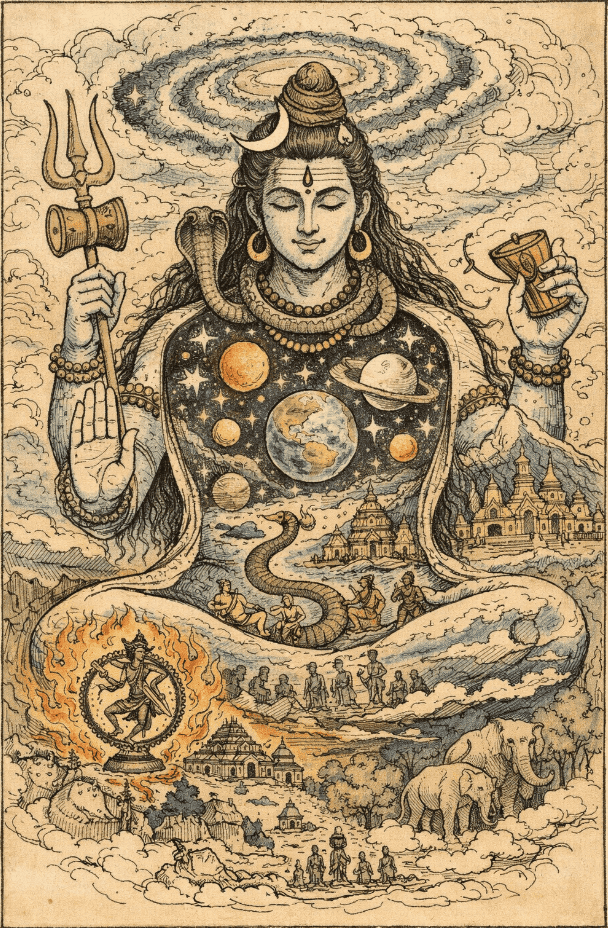
A striking paradox defines Shiva’s nature: he rejects thrones, crowns, palaces, and all symbols of earthly power, choosing instead the life of an ascetic on Mount Kailash. He dwells amid snow-capped peaks, smeared with ash, clad in tiger skin, adorned only with serpents, rudraksha beads, and the crescent moon. He meditates in deep silence or performs the cosmic dance of Tandava. Despite this complete renunciation of worldly authority, Shiva commands supreme cosmic authority. No other god equals his power; even Brahma and Vishnu acknowledge his supremacy in key myths.
This article examines why Shiva discards earthly power yet holds absolute dominion over the universe, drawing from Hindu scriptures such as the Shiva Purana, Linga Purana, and various Puranic narratives.
Article Structure
The Ascetic Ideal: Renunciation as True Strength
In Hindu philosophy, true power arises not from accumulation but from detachment. Shiva embodies this principle perfectly. As the Mahayogi, the supreme yogi, he practices intense tapas (austerity) to transcend the illusions of maya (worldly attachment). Scriptures describe him as dwelling in cremation grounds, surrounded by ashes, skulls, and ghosts, symbolizing his mastery over death and impermanence.
Shiva’s rejection of thrones reflects a deliberate choice. Thrones represent material sovereignty, control over kingdoms, wealth, armies, and subjects. Such power binds one to samsara, the cycle of birth and death. By refusing it, Shiva demonstrates that genuine authority stems from inner realization, not external dominion. In the Shiva Purana, his ascetic form underscores detachment from ego, desire, and possession. He smears vibhuti (sacred ash) on his body, a reminder that all forms reduce to ash; thus, clinging to worldly status proves futile.
This renunciation aligns with yogic teachings. Shiva, as Adiyogi (the first yogi), transmitted yoga knowledge to the Saptarishis (seven sages). His life illustrates that spiritual discipline grants control over mind, senses, and cosmic forces, far superior to political or military might.
Supremacy Without Possession in Sacred Narratives
Several profound stories from Puranic literature reveal why Shiva needs no throne yet remains supreme.
One central narrative involves the famous dispute between Brahma and Vishnu over supremacy. Both claimed primacy. Suddenly, an infinite pillar of fire (jyotirlinga) appeared, stretching endlessly in all directions. Brahma, taking the form of a swan, flew upward to find its top; Vishnu, as a boar, burrowed downward to locate its base. Neither succeeded. Exhausted, they returned to find Shiva emerging from the pillar. He declared himself beyond beginning and end, the eternal, self-existent reality. Brahma and Vishnu bowed in reverence, accepting Shiva’s absolute authority.
This pillar symbolizes Shiva’s formless essence (nirguna Brahman), transcending space and time. No throne confines him because he pervades everything. The story, found in texts like the Shiva Purana and Linga Purana, affirms that cosmic sovereignty belongs inherently to Shiva; others merely participate in it.
Another tale highlights Shiva’s effortless supremacy. In the churning of the cosmic ocean (Samudra Manthan), gods and demons sought amrita (nectar of immortality). The process released halahala poison, threatening universal destruction. Gods and demons fled; only Shiva stepped forward, swallowing the poison to save creation. His throat turned blue (earning the name Neelkantha), but he held the venom without harm. Vishnu and other deities could not neutralize it; Shiva’s act proved his unmatched protective power.
Here, Shiva acts not as a king issuing commands but as the ultimate guardian. His ascetic detachment enables selfless intervention, no attachment to glory or fear of loss motivates him.
Stories of Shiva’s fierce forms, such as Bhairava or Veerabhadra, further illustrate this. When Daksha insulted Shiva by excluding him from a grand yajna (sacrifice), Shiva did not retaliate personally. He created Veerabhadra from his anger, who destroyed the sacrifice and humbled Daksha. Shiva remained detached, yet his will prevailed universally.
Household Life Without Loss of Detachment
Shiva’s marriage to Parvati and his role as a householder might appear to contradict his asceticism. Purāṇic accounts resolve this by presenting Parvati as Shakti itself, not a distraction from renunciation but its complement.
Myths describe concerns among the gods that Shiva’s extreme ascetic withdrawal could destabilize cosmic continuity. Parvati’s union with Shiva restores balance, allowing participation in worldly processes without attachment. Even as a husband and father, Shiva retains the same inward detachment. His authority does not diminish because it never depended on withdrawal alone.
This synthesis is central to Shaiva thought. Supreme authority accommodates opposites without being bound by either.
Philosophical Reasons: Why Asceticism Grants Supreme Authority
Hindu thought distinguishes between aparavidya (worldly knowledge) and paravidya (supreme knowledge). Thrones belong to the former, transient and limited. Supreme authority arises from the latter: realization of oneness with Brahman.
Shiva, as Sadashiva or Maheshwara, embodies this. In Shaivism, he is svayambhu (self-born), eternal, and unchanging. His ascetic life signifies transcendence of the three gunas (sattva, rajas, tamas) that govern material existence. By mastering them, he controls the cosmos.
The trident (trishul) he carries symbolizes dominion over these gunas, not conquest through force. His damaru (drum) produces the primal sound (nada) from which creation emerges. Even his residence on Kailash, remote and inaccessible, underscores detachment from worldly centers of power.
Asceticism purifies the mind, granting siddhis (spiritual powers) and insight into reality. Shiva’s third eye, when opened, destroys illusion (as when he burned Kamadeva, the god of desire). This inner fire surpasses any external weapon or throne.
Renunciation frees one from karma’s bonds. Kings accumulate karma through rule; Shiva, unbound, acts spontaneously for universal welfare. His authority is svatantra (self-willed), not dependent on subjects or alliances.
Lessons for Modern Life – Relevance Beyond Theology
Shiva’s example offers timeless guidance. In a world obsessed with status, wealth, and control, his rejection of thrones teaches that true leadership arises from inner strength and detachment. Power pursued for ego leads to bondage; power born of realization uplifts all.
Professionals in high positions may reflect: Does authority serve self-aggrandizement or greater good? Shiva shows detachment enhances effectiveness, one acts without fear of loss or craving for gain.
Spiritually, his path encourages meditation and self-inquiry. By letting go of attachments, one accesses inner authority, the atman identical to Brahman.
In Shaiva philosophy, recognizing Shiva within dissolves false hierarchies. Everyone carries potential for supreme realization, beyond external thrones.
Shiva’s Renunciation and Cosmic Authority in Shaiva Thought
Shiva rejects thrones because they represent temporary power sustained by form, possession, and recognition. His authority arises from renunciation, not absence of power, but freedom from dependence. Purāṇic narratives consistently affirm this vision. The infinite pillar defies measurement, poison submits to restraint, and sacrifice collapses without confrontation.
Shiva’s ascetic life is not withdrawal from responsibility but the condition that enables universal action without attachment. By choosing ash over gold and silence over command, he reveals a deeper principle. True authority lies in mastery of self and reality, not dominion over others.
Shiva remains supreme not because he rules the cosmos, but because the cosmos unfolds within him. His authority needs no throne because it precedes and transcends all symbols of rule.