
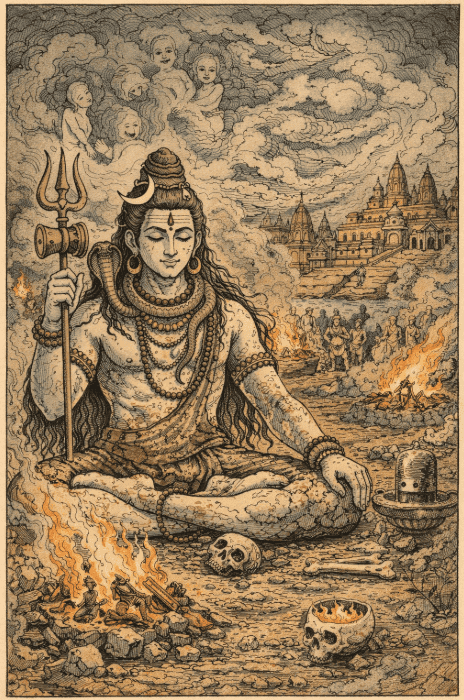
Lord Shiva, revered as Mahadeva, embodies some of the most striking paradoxes within Hinduism. In the Trimurti, he appears as the force of dissolution, yet within Shaiva traditions he is understood as the ultimate reality from which creation, preservation, and dissolution arise. Among his many unconventional attributes, one remains especially arresting: his association with the smashana, the cremation ground.
While other deities are described as dwelling in celestial realms or resplendent abodes, Shiva is repeatedly portrayed as Shmashana Adhipati, the lord of the cremation ground. He meditates amid funeral pyres, ashes, and the remnants of mortal existence, his body smeared with vibhuti drawn from these very sites. This choice is neither accidental nor morbid. It expresses a deliberate philosophical position rooted in liberation, detachment, and the direct confrontation with impermanence.
Shiva’s dwelling in the smashana reveals why he is regarded as the god of liberation. The cremation ground is where worldly identities dissolve, illusions collapse, and the reality of existence stands exposed. By choosing this space, Shiva situates himself at the threshold where ignorance ends and freedom begins.
Article Structure
The Symbolic Meaning of the Cremation Ground – as a Space of Truth
In Hindu thought, the smashana is far more than a place for disposing of the dead; it is a sacred space where the veil of maya (illusion) is torn away. Bodies that once held beauty, status, wealth, and relationships are reduced to ash in moments. This process underscores anitya, the impermanence of all physical forms. Scriptures emphasize that everything composed of the five elements (earth, water, fire, air, ether) returns to its source. The cremation fire symbolizes transformation: it destroys the gross body while liberating the subtle essence, the atman (soul), for its onward journey.
Shiva’s residence here signifies his complete embrace of this truth. He does not avoid death or decay; he dwells within it. By choosing the smashana, he teaches that liberation arises from accepting impermanence rather than fleeing from it. Attachments to body, possessions, relationships, and identity create suffering; the cremation ground strips these away, revealing the eternal reality beneath. As the ultimate liberator, Shiva positions himself at the point where worldly illusions end, guiding souls beyond the cycle of samsara (birth and death).
Furthermore, the smashana transcends conventional notions of purity and impurity. In ordinary perception, it appears unclean and frightening. Yet for one who has transcended duality, no place is impure. Shiva’s presence sanctifies the site, transforming it into a realm of profound spiritual potency. Tantric traditions, particularly Vamachara paths, view the cremation ground as ideal for sadhana (spiritual practice), as it compels the practitioner to confront mortality directly and dissolve distinctions between holy and unholy.
Scriptural Portrayals of Shiva in the Smashana
Hindu scriptures consistently portray Shiva as associated with cremation grounds. The Shiva Purana, one of the principal texts glorifying him, describes his ascetic form and preference for such locales. In various sections, including the Dharma Samhita, his dwelling underscores renunciation and focus on ultimate truth.
The Mahabharata, in the Anushasana Parva, records a dialogue where Parvati (Uma) questions Shiva about his choice. She notes his heavenly abodes of luxury and asks why he prefers the crematorium. Shiva responds that the smashana is the most sacred spot, shaded by banyan trees and adorned with remnants of offerings. It pleases him because his companions, the ganas (ghostly beings), reside there. He declares it akin to heaven, free from worldly distractions.
The Bhagavata Purana (Skanda 4, Adhyaya 4, Shloka 16) also references Shiva’s residence in cremation grounds, linking it to his impartiality toward all beings. As the indwelling soul in every creature, he discriminates against none, not even ghosts or spirits. This non-dual vision explains his comfort amid what others fear.
In Tantric literature and certain Puranic accounts, Shiva manifests as Bhairava, his fierce form, in the smashana. One prominent myth describes Bhairava emerging from Shiva’s wrath when Brahma’s fifth head insulted him with arrogance. Shiva severs the head, but the skull adheres to Bhairava’s hand as a mark of brahmahatya (Brahmin-killing sin). Bhairava wanders as an ascetic, the skull serving as his begging bowl until it falls in Varanasi (Kashi), a city famed for its cremation ghats. This narrative establishes cremation grounds as sites of penance, protection, and liberation. Bhairava, often called Smashana Bhairava, guards these spaces, granting devotees freedom from fear and sin.
Varanasi itself exemplifies this symbolism. As the city of Kashi Vishwanath (Shiva as the lord of the universe), its Manikarnika Ghat, the primary cremation ground, is considered exceptionally sacred. Shiva resides here eternally, ensuring moksha for those cremated on its banks. The Skanda Purana and Varanasi Mahatmya highlight Kalarudra (a fierce form of Shiva) in smashana settings, where dissolution leads to renewal.
Detachment, Fearlessness, and the Conquest of Death
Shiva’s choice reflects core principles of detachment (vairagya) and fearlessness (abhaya). As the Mahayogi, he practices extreme tapas in remote, austere places. The smashana represents the pinnacle of renunciation: no comforts, no distractions, only the raw truth of existence. By meditating there, Shiva demonstrates mastery over the mind’s tendencies toward attachment and aversion.
Death evokes universal fear because it threatens the ego’s sense of permanence. Shiva, as Mrityunjaya (conqueror of death), remains untouched. His presence teaches that true liberation comes from transcending fear. When one realizes the atman as eternal, death loses its terror; the body is merely a temporary garment. The smashana becomes a classroom for this realization.
In Shaivism, Shiva embodies nirguna Brahman, the formless absolute, yet manifests saguna forms for devotees. His smashana dwelling bridges the transient and eternal. He destroys not out of malice but to facilitate renewal. Just as fire purifies gold, cremation fire liberates the soul from karmic bonds.
This symbolism extends to spiritual practice. Ascetics and tantrics perform sadhana in cremation grounds to cultivate detachment. Facing ghosts and impermanence erodes ego, fostering direct experience of the divine. Shiva’s ganas, often depicted as deformed or fearsome, symbolize acceptance beyond societal norms of beauty and normalcy.
Meaning for Contemporary Seekers
In contemporary life, marked by relentless pursuit of material success, security, and longevity, Shiva’s smashana symbolism offers a counterbalance. It reminds us that wealth, status, and relationships are transient. Clinging to them breeds anxiety; releasing them brings freedom.
Practically, this encourages mindfulness of death (maranasati in some traditions), not as morbid but as a spur to live meaningfully. Daily reflection on impermanence reduces attachment, sharpens priorities, and deepens compassion. Applying vibhuti on the forehead emulates Shiva, serving as a constant reminder: “This body will return to ash; focus on the eternal.”
For those facing loss or grief, Shiva’s presence in the smashana provides solace. He waits there not to terrify but to liberate, ensuring no soul remains trapped in illusion. Devotees chant mantras like Om Namah Shivaya at cremations, invoking his grace for peaceful transition.
Conclusion – The Cremation Ground in Shiva’s Path of Renunciation
Lord Shiva chooses the cremation ground as his dwelling because it is the truest reflection of reality: impermanence, transformation, and liberation. As the God of Liberation, he embraces what others shun, demonstrating that detachment from life-death illusions grants supreme freedom. Myths from the Shiva Purana, Mahabharata, and Tantric traditions affirm this; philosophical insights reveal its depth.
By residing in the smashana, Shiva teaches that enlightenment lies not in avoiding death but in transcending it through awareness and renunciation. In his ash-smeared form, amid flickering pyres, he reveals the path beyond transient existence, to the eternal, unchanging self.
Contemplating this aspect of Mahadev inspires seekers to confront fears, release attachments, and realize their divine nature. In the silence of the cremation ground, where all illusions burn away, Shiva awaits, not as destroyer, but as the ultimate liberator, guiding every soul home.