
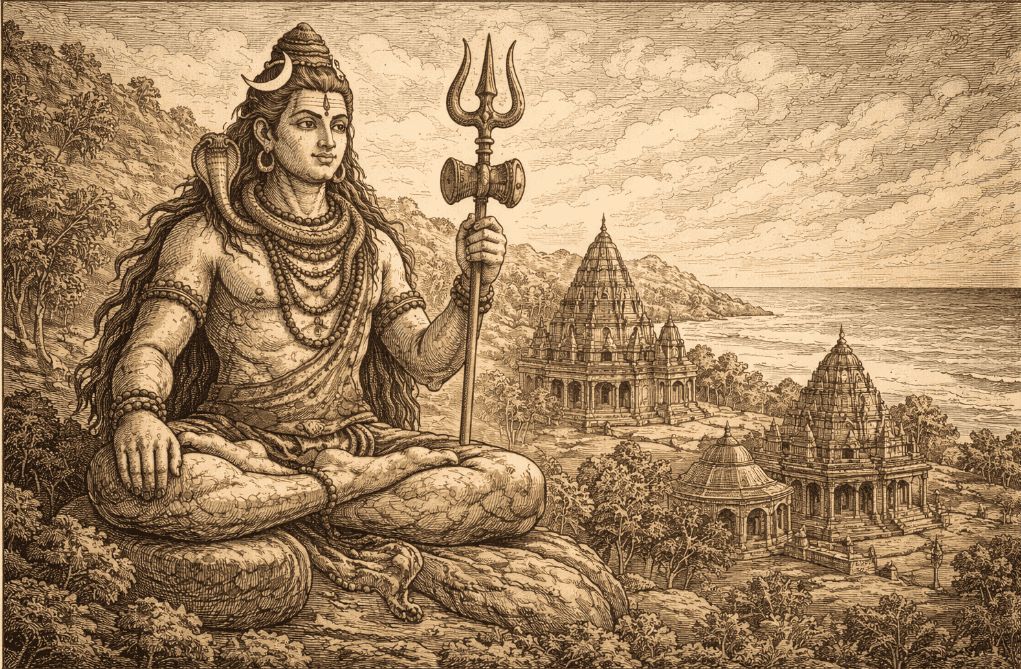
Lord Shiva, revered as Mahadev, the Great God, holds a distinctive weapon: the Trishul (trident). This three-pronged implement, often depicted with a long shaft and sharp points, forms one of the most recognizable elements of his iconography. While many deities conventional weapons as symbols of combat and protection, Shiva bears the Trishul. Shiva’s choice of the weapon is deliberate and deeply symbolic.
The Trishul represents transcendence rather than conquest. It signifies mastery over the three gunas that govern material existence, authority over the cosmic cycle of creation, preservation, and dissolution, and sovereignty rooted in balance rather than violence. Unlike a conventional sword, which primarily represents cutting or defeat of external enemies, the trishul operates on cosmic and spiritual dimensions. This article explores why Shiva bears the trishul instead of a sword, drawing from Puranic narratives and Shaiva philosophy.
Origins of the Trishul: Divine Craftsmanship
Scriptural accounts trace the trishul’s creation to divine processes rather than human invention. According to the Vishnu Purana, the sun god Surya married Sanjna, daughter of the celestial architect Vishvakarma. Unable to endure Surya’s intense brilliance, Sanjna sought her father’s help. Vishvakarma reduced Surya’s radiance to one-eighth of its original intensity. The excess solar energy descended to Earth, which Vishvakarma harnessed to forge powerful divine weapons. From this solar essence, he crafted the trishul for Shiva, the Sudarshana Chakra for Vishnu, a lance for Kartikeya, and other armaments for the gods.
This origin story positions the trishul as an instrument of pure, radiant energy, solar power transformed into a tool of cosmic balance. The Shiva Purana further describes Shiva as svayambhu (self-manifested), born of his own volition, and holding the trishul from the dawn of creation. Unlike a sword, forged for battle against foes, the trishul emerges as an eternal attribute of Shiva’s supreme nature, symbolizing inherent authority rather than acquired might.
The Three Prongs: Transcendence Over the Three Gunas
The trishul’s defining feature, its three prongs, distinguishes it from a sword’s single blade. In Shaiva philosophy, these prongs represent the three gunas, the fundamental qualities that govern all material existence and human experience.
- Sattva: The prong of purity, harmony, clarity, and enlightenment. It promotes knowledge, balance, and spiritual elevation.
- Rajas: The prong of activity, passion, energy, and desire. It drives motion, ambition, and change.
- Tamas: The prong of inertia, ignorance, darkness, and resistance. It leads to stagnation, delusion, and obstruction.
Shiva, as the supreme consciousness beyond prakriti (nature), wields the trishul to signify mastery and transcendence over these gunas. A sword might symbolize severance or dominance over opposition, but the trishul illustrates harmonious control: Shiva integrates and surpasses sattva, rajas, and tamas, guiding creation toward equilibrium. By holding the trishul, he demonstrates that true sovereignty arises from rising above these qualities, not from subduing them through force.
This symbolism aligns with yogic teachings, where balancing the gunas leads to spiritual progress. Devotees meditate on the trishul to cultivate detachment from rajasic impulses and tamasic lethargy, aspiring toward sattvic purity and ultimate liberation.
Mastery of the Cosmic Cycle: Creation, Preservation, Destruction
The trishul also embodies the eternal cycle of srishti (creation), sthiti (preservation), and samhara (destruction), functions associated with Brahma, Vishnu, and Shiva respectively. Shiva, as the destroyer, facilitates dissolution to enable renewal, ensuring the universe does not stagnate.
The three prongs signify this triad: one for creation (Brahma’s role), one for preservation (Vishnu’s equilibrium), and one for destruction (Shiva’s transformative power). Shiva bears the trishul to affirm his oversight of the entire cycle. A conventional sword might represent destruction alone, cutting down adversaries or obstacles, but the trishul encompasses all phases, highlighting balanced sovereignty. Shiva does not merely end; he initiates rebirth through dissolution.
Myths illustrate this cosmic role. In one narrative from the Shiva Purana and related texts, Shiva uses the trishul to destroy the three flying cities (Tripura) of the demon Tripurasura. These cities symbolized imbalance and arrogance; Shiva’s single strike with the trishul annihilated them, restoring universal harmony. This act underscores the weapon’s power to correct disequilibrium across creation, preservation, and destruction.
Another account from the Mahabharata describes Shiva employing the trishul against the demon Andhaka, who embodied uncontrolled desire and chaos. The trishul eradicated not only the demon but the root causes of suffering, ego, attachment, and illusion, revealing its role in spiritual purification.
Beyond Mere Weaponry: Symbol of Balanced Sovereignty
A sword typically denotes linear action, attack, defense, victory in conflict. It suits warrior deities focused on protection or conquest. The trishul, however, conveys multidimensional authority. Its prongs point upward, suggesting ascension toward higher consciousness rather than horizontal combat.
In Shaivism, the trishul represents sovereignty that is balanced and transcendent. Shiva holds it effortlessly, often alongside the damaru (drum), symbolizing the union of sound (creation) and silence (dissolution). This pairing illustrates how the trishul governs the rhythm of existence without aggression.
The weapon also links to time (kala): past, present, and future. Shiva transcends trikaal (the three periods), wielding the trishul to maintain order across temporal dimensions. A sword might conquer in the present; the trishul ensures harmony across eternity.
Additionally, some interpretations connect the central prong to the sushumna nadi (central energy channel in yoga), with side prongs representing ida and pingala. This yogic symbolism emphasizes spiritual ascent and balance of energies, far removed from martial connotations.
Trishul – Cultural and Devotional Significance
In temples and homes, the trishul stands as a sacred emblem. Devotees place it near the Shiva lingam or offer prayers to it for protection, mental clarity, and liberation from the gunas’ grip. Large trishuls adorn temple entrances or peaks, such as the monumental one at Pandaveshwor Temple in Nepal, weighing over 81 quintals, symbolizing enduring devotion.
Worship involving the trishul encourages reflection on personal balance: cultivating sattva, moderating rajas, and overcoming tamas. It inspires seekers to transcend ego and illusion, aligning with Shiva’s path of renunciation and realization.
The Trishul and Shiva’s Role in Creation and Dissolution
Lord Shiva bears the trishul rather than a conventional sword because this divine implement encapsulates transcendence over the three gunas, mastery of the cosmic cycle of creation-preservation-destruction, and a sovereignty rooted in equilibrium rather than conflict. Forged from solar essence according to the Vishnu Purana and inherent to Shiva’s self-manifested nature in the Shiva Purana, the trishul transcends physical combat to symbolize spiritual authority, cosmic balance, and liberation.
Myths of Tripurasura, Andhaka, and others demonstrate its power to restore harmony by piercing ignorance and imbalance. Unlike a sword’s focus on severance, the trishul integrates and surpasses dualities, guiding devotees toward inner mastery and ultimate freedom.
Contemplating Shiva’s trishul invites recognition of life’s triadic nature, qualities, cycles, time, and the possibility of rising above it through awareness and detachment. In this profound symbol, Mahadev reveals not domination, but the serene, all-encompassing sovereignty of the eternal self.