
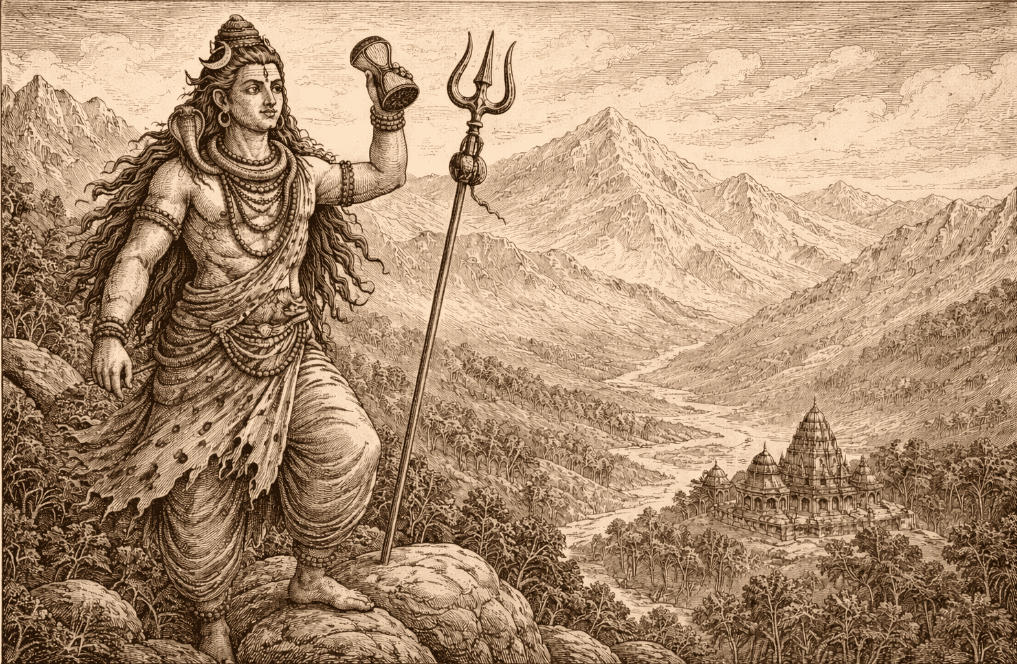
Lord Shiva, expresses the deepest truths of existence through his form and attributes. Among these, the damaru, a small hourglass-shaped drum, holds a central and distinctive place. Crafted with two membranes joined by a narrow waist and sounded by twisting the wrist so knotted cords strike its surfaces, the damaru produces a sharp, pulsating rhythm.
Shiva holds the damaru most famously in his Nataraja form, as he performs the cosmic dance, the Tandava. Though modest in size, this instrument symbolizes the primordial rhythm that underlies all creation. In Shaiva thought, it represents Nada, the subtle vibration from which form, motion, and time emerge. Through the damaru, Shiva is understood as the source of cosmic rhythm, the principle by which the universe unfolds, sustains itself, and dissolves.
Article Structure
The Physical Form and Mechanism of the Damaru
The damaru’s design is elegantly simple yet symbolically rich. Its hourglass shape features two hollow chambers connected by a narrow waist, often bound with leather or rope. A string threaded with small beads or knots passes between the heads. When Shiva twists his wrist, the beads strike the membranes alternately, generating a clear, resonant beat without direct hand contact. This mechanism produces a pulsating rhythm that alternates between sharp and sustained tones.
In iconography, particularly the Nataraja bronze sculptures from the Chola period (9th-13th centuries CE) in South India, the Damaru appears in Shiva’s upper right hand. The dance’s vigorous movements cause the instrument to sound continuously, emphasizing its integral role in cosmic activity.
Mythological Origins: The First Sound in the Void
Hindu scriptures describe the universe beginning in silence and void. The Shiva Purana and related texts narrate that Shiva, in his meditative state, initiated creation by sounding the damaru. This first vibration, known as Nada or Anahata Nada (the unstruck sound), emerged from nothingness. It broke the primordial silence, setting in motion the processes of manifestation.
One prominent account states that Shiva played the damaru fourteen times, producing sacred sounds that formed the foundation of structured speech. These vibrations gave rise to the Maheshwara Sutras, fourteen verses that Sage Panini, the grammarian, received in a vision of Shiva’s dance. Panini used them to formulate the rules of Sanskrit grammar in his Ashtadhyayi, establishing the language as divine and precise. Thus, the damaru is credited with originating not only cosmic sound but also linguistic structure, underscoring Shiva’s role as the progenitor of all sounds, languages, music, and vibrations.
In another narrative, the damaru’s beat during the Tandava marked the emergence of Om, the primal syllable encompassing creation (A), preservation (U), and dissolution (M). This sound, Nada Brahma, signifies that the universe is fundamentally vibration, everything arises from and returns to this eternal resonance.
Symbolism in the Cosmic Dance: Tandava and Nataraja
The damaru’s deepest significance unfolds in Shiva’s Tandava, particularly the Ananda Tandava (dance of bliss) depicted in the Nataraja form. Here, Shiva dances within a ring of flames (prabhamandala), symbolizing the cycle of existence. His upper right hand holds the damaru, beating the rhythm of creation; the upper left holds fire (agni), representing destruction; one hand offers the abhaya mudra (fear-not gesture) for protection; and another points downward in the gajahasta (elephant-trunk) pose, guiding toward liberation.
The damaru initiates the cosmic rhythm: its beats synchronize with the universe’s expansion and contraction. Each vibration corresponds to cycles of srishti (creation), sthiti (preservation), and samhara (destruction). The hourglass shape mirrors this duality, two opposing chambers united at the center, representing Shiva and Shakti (pure consciousness and dynamic energy) merging to generate existence. When played, the dissimilar sounds from each side fuse into harmonious resonance, symbolizing the transcendence of opposites into unity.
In Shaiva philosophy, particularly Kashmir Shaivism, this relates to spanda, subtle vibration, as the essence of reality. The damaru embodies the pulse of the cosmos, akin to a heartbeat sustaining life. Its rhythm echoes the eternal cadence: rising and falling, manifesting and withdrawing, without beginning or end.
Philosophical Depth: Nada as the Source of All
In Shaivism, sound precedes form. The Upanishads and Tantric texts describe Nada as the subtle vibration underlying gross matter. The damaru represents Shabda Brahman (sound as Brahman), the sonic aspect of the absolute. Om emerges from its beats as the seed syllable, containing all potentialities. Chanting Om aligns the individual with cosmic vibration, leading to spiritual awakening.
The damaru also signifies the union of Nada (sound) and Bindu (point of origin), vibration and stillness converging. This duality reflects the interplay of Shiva (static consciousness) and Shakti (dynamic power). The instrument’s two heads symbolize Purusha (consciousness) and Prakriti (nature), bound by a cord representing the embodied soul (jiva) caught in cycles until liberation.
Devotees view the damaru’s sound as purifying: it aligns chakras, removes blockages, and fosters inner harmony. In meditation, focusing on its imagined rhythm induces states of transcendence, revealing the unstruck sound (Anahata Nada) within.
Ritual, Culture, and Living Tradition
The damaru appears in rituals, particularly among Shaiva ascetics like Naga Sadhus, who carry it during processions or worship to invoke Shiva’s presence. Its beats announce sacred intent and ward off negativity. In classical Indian music and dance, such as Bharatanatyam, rhythms inspired by the damaru evoke cosmic themes.
Temples like Chidambaram in Tamil Nadu, the center of Nataraja worship, emphasize the damaru’s role in the eternal dance performed at the heart of the universe, and the human heart.
Modern Resonance and Lessons
The damaru’s symbolism offers timeless insights. In an era of constant change, it reminds us that existence follows rhythmic cycles: beginnings follow endings, activity follows rest. Embracing this flow cultivates equanimity.
Spiritually, it encourages attunement to inner vibration through mantra, music, or silence. Sound healing practices draw from this, using rhythms to reduce stress and promote balance, echoing ancient wisdom that vibration transforms consciousness.
Conclusion – Shiva’s Damaru and the Sacred Role of Sound
The damaru in Shiva’s hand is far more than a musical instrument. It symbolizes the primordial rhythm that underlies existence, the subtle vibration from which form, language, and consciousness arise. Through myths preserved in Shaiva tradition, the vision of Panini, and the iconography of Nataraja, the damaru stands as an emblem of sound as structure and rhythm as order.
By holding the damaru, Shiva reveals that creation is not chaotic but rhythmic, not forced but spontaneous. To contemplate this symbol is to recognize that beneath change lies an unbroken pulse, steady, eternal, and silent at its core. In that rhythm, the seeker finds not noise, but clarity, not motion alone, but balance.