
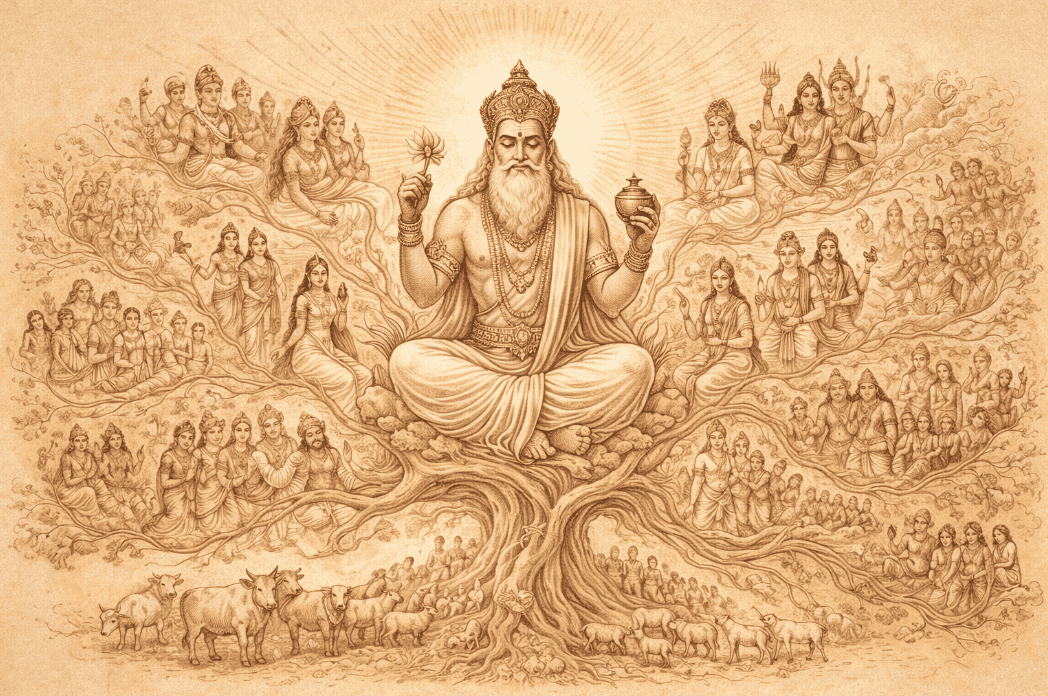
In the vast expanse of Hindu mythology, few figures embody the essence of creation and progeny as profoundly as Daksa Prajapati. As a mind-born son of Brahma, the creator god, Daksa rose to prominence among the divine architects of the universe. His journey from a primordial being to a foremost progenitor involves intricate tales of birth, marriage, creation, and conflict. This post explores Daksa’s origins, his pivotal role in populating the cosmos, and the events that solidified his status, drawing from ancient scriptures such as the Puranas and Vedas. Through these narratives, we gain insight into the structured hierarchy of creation in Hindu cosmology.
Article Structure
The Origins of Daksha: A Mind-Born Son of Brahma
Daksa Prajapati emerges as one of the earliest entities in Hindu creation myths. According to the Puranas, such as the Vishnu Purana and Matsya Purana, Daksa was born directly from the mind of Brahma, the supreme creator. This process, known as Manasaputra or mind-born progeny, signifies that Daksa did not arise through physical birth but through Brahma’s mental resolve. In specific accounts, Daksa originates from Brahma’s right thumb, symbolizing skill and dexterity, as the name “Daksa” itself means “able” or “dexterous” in Sanskrit.
In the Vedic period, as described in the Rigveda, Daksa is listed among the Adityas, the solar deities and sons of Aditi. Here, he represents priestly skills and ritual proficiency, essential for maintaining cosmic order. Over time, his identity evolves in the Itihasa-Puranic texts, where he becomes one of the Prajapatis, lords of creatures tasked with propagation. The Brahmanas, dating from 900 BCE to 700 BCE, identify Daksa with Prajapati, the overarching creator deity, blending his role into the broader framework of cosmic generation.
Brahma, facing the challenge of an empty universe after initial creation, produced ten mind-born sons, including Marichi, Atri, Angiras, Pulastya, Pulaha, Kratu, Vashistha, Narada, Bhrigu, and Daksa. These sons were assigned to expand life across realms. Daksa’s early prominence stems from his designation as a Prajapati, a title denoting authority over procreation. Unlike others who focused on asceticism or wisdom, Daksa emphasized practical creation through offspring, setting the stage for his ascent.
This mind-born origin granted Daksa inherent divine powers, free from mortal limitations. It positioned him as a bridge between the abstract creator Brahma and the tangible world of beings. His rise began with this foundational role, as Brahma delegated the task of populating the earth to him, recognizing his capability for large-scale generation. In essence, Daksa’s birth marked the initiation of organized creation, where mental conception transitioned into physical manifestation.
Marriages and Progeny: The Foundation of Daksha’s Power
Daksa’s ascent to power is closely tied to his marriages and the vast progeny he sired, which populated the divine and mortal realms. In the Puranas, Daksa marries Prasuti, the daughter of Svayambhuva Manu, the first human, and Shatarupa. With Prasuti, he fathers between 16 and 60 daughters, depending on the text. The Vishnu Purana lists 24 daughters, embodying virtues such as Sraddha (faith), Lakshmi (prosperity), Dhriti (steadiness), Khyati (fame), Sambhuti (fitness), Smriti (memory), Priti (affection), Kshama (patience), Sannati (humility), Anasuya (charity), Urjja (energy), Svaha (offering), and Svadha (oblation), along with Sati.
These daughters were strategically married to prominent deities and sages, amplifying Daksa’s influence. For instance, Khyati wed Bhrigu, Sati married Shiva, Svaha went to Agni, and Svadha to the Pitris (ancestors). Such alliances connected Daksa to the core of cosmic functions, from fire rituals to ancestral worship.
Additionally, Daksa marries Asikni (also called Veerni or Panchajani), daughter of Virana Prajapati. With her, he produces 60 daughters in some accounts, including 10 to Dharma (such as Maruvati and Vasu), 13 to Kashyapa (Aditi, Diti, Danu, etc., mothers of gods and demons), 27 to Chandra (the lunar mansions or Nakshatras like Ashvini and Rohini), and others to sages like Arishtanemi and Angiras. This extensive lineage made Daksa the grandfather of countless beings, including the Devas, Asuras, and celestial bodies.
Daksa also fathered sons with Asikni: 5,000 Haryashvas and 1,000 Shabalashvas, intended to multiply humanity. However, influenced by Narada’s teachings on renunciation, they wandered off, prompting Daksa to curse Narada to eternal wandering. This episode highlights Daksa’s frustration with obstacles to creation but also his determination to persist.
Through these unions, Daksa established a network of divine relationships, enhancing his status. His progeny filled the universe with gods, sages, humans, and celestial entities, making him indispensable in the creative hierarchy. Brahma’s delegation of propagation duties, as per the Brahmanda Purana, came after Daksa’s initial mental creations failed to expand sufficiently. Performing penance at the Vindhya mountains, Daksa received Asikni from Vishnu, enabling physical procreation and solidifying his role as foremost progenitor.
Daksha’s Role in Cosmic Creation and Governance
As a Prajapati, Daksa’s primary duty was to act as an agent of creation under Brahma’s guidance. In Hindu cosmology, creation unfolds in cycles called Manvantaras, and Daksa features prominently in the Svayambhuva Manvantara. He creates gods, sages, Asuras, Yakshas, and Rakshasas initially through mental effort, but recognizes the need for sexual reproduction to sustain growth.
The Vayu Purana details how Daksa, after creating beings from his mind, sees them fail to multiply. He then adopts the method of union, producing diverse life forms. This shift marks his innovation in creation, elevating him above other Prajapatis who remained more contemplative.
Daksa’s governance extended to ritual and order. As a divine king-rishi, he organized sacrifices to maintain dharma (cosmic law). His association with Agni (fire) in sacrifices underscores his priestly heritage from Vedic times. In the Mahabharata, Daksa is depicted as a ruler who commands respect from gods, inviting even Brahma and Vishnu to his events.
His power peaked through these creative acts, positioning him as a central figure in the divine assembly. Symbolically, Daksa represents the vital force of procreation, contrasting with ascetic figures like Shiva. His extensive family tree ensured the continuity of life, making him a pillar among creators. This role not only granted him authority but also invited conflicts, as seen in later tales.
The Daksa Yajna: Conflict, Destruction, and Redemption
One of the most dramatic episodes in Daksa’s life is the Daksa Yajna, illustrating both his hubris and eventual humility. As detailed in the Linga Purana and Shiva Purana, Daksa organized a grand fire-sacrifice called Brihaspatistava Yajna to assert his supremacy. He invited all deities except Shiva and Sati, his daughter, due to disdain for Shiva’s ascetic lifestyle and unconventional ways.
Daksa viewed Shiva as unfit for royalty, preferring alliances that enhanced his power. Sati, devoted to Shiva, attended uninvited but faced insults from her father. In despair, she immolated herself in the sacrificial fire, protesting the dishonor.
Enraged, Shiva created Virabhadra and Bhadrakali from his locks, who stormed the yajna site. They destroyed the assembly, decapitating Daksa (or plucking his head in some versions) and injuring other gods. The chaos ended when Brahma and Vishnu intervened, pleading for mercy. Shiva revived Daksa but replaced his head with that of a goat, symbolizing the loss of ego and the need for humility.
Post-revival, Daksa acknowledged Shiva’s supremacy, completing the sacrifice with devotion. This event humbled him but reaffirmed his role, as the yajna’s success maintained cosmic balance. Symbolically, the goat head represents stubbornness transformed into sacrifice, aligning with Daksa’s creative essence.
This conflict highlighted Daksa’s power, he could convene the gods, but also his limitations, ensuring his rise was tempered by divine order.
Other Narratives: The Curse on Chandra and Rebirth
Beyond the yajna, Daksa’s influence appears in other stories. He cursed Chandra, the moon god, for favoring Rohini among his 27 Nakshatra daughters (married to Chandra). Chandra’s neglect caused the others distress, leading Daksa to curse him with consumption (waning), later mitigated by Shiva to allow waxing phases. This tale underscores Daksa’s protective role over his progeny and his authority in celestial matters.
In another cycle, after his death in the yajna, Daksa is reborn in the Chakshusha Manvantara as the son of the ten Prachetas brothers and Marisha. The Prachetas, sons of Barhishad, performed penance underwater for 10,000 years before marrying Marisha, who bore Daksa anew. In this incarnation, he continues propagation, emphasizing cyclical creation in Hinduism.
These stories portray Daksa as a resilient figure, whose power endures through rebirth and intervention in divine affairs.
Later Role, and Continuing Influence
Daksa’s legacy endures as a symbol of creation’s dual nature: abundance through progeny and the perils of arrogance. In iconography, he is depicted as stocky, sometimes with a goat head post-yajna, holding ritual items. His narratives in texts like the Mahabharata and Puranas illustrate the tension between ritualistic order (Daksa) and transcendent chaos (Shiva).
Symbolically, Daksa represents the vital plane’s descent from pure consciousness, as interpreted in some esoteric views. His rise reflects the necessity of structured procreation in cosmology, where Prajapatis like him ensure life’s continuity.
In modern contexts, Daksa’s tales teach lessons on humility, family bonds, and cosmic harmony. Temples dedicated to him, though rare, exist in places like Kankhal, associated with the yajna site.
Conclusion: Daksa’s Enduring Influence Among Creators
Daksa Prajapati’s rise from a mind-born son of Brahma to a foremost progenitor exemplifies dedication to creation amid divine challenges.
Through marriages, progeny, and pivotal events like the yajna, he secured his place in Hindu mythology. His story reminds us of the balance required in power, creation thrives when tempered with respect for higher forces. As we reflect on these ancient narratives, Daksa’s journey offers profound insights into the origins of life and the universe’s intricate design.