
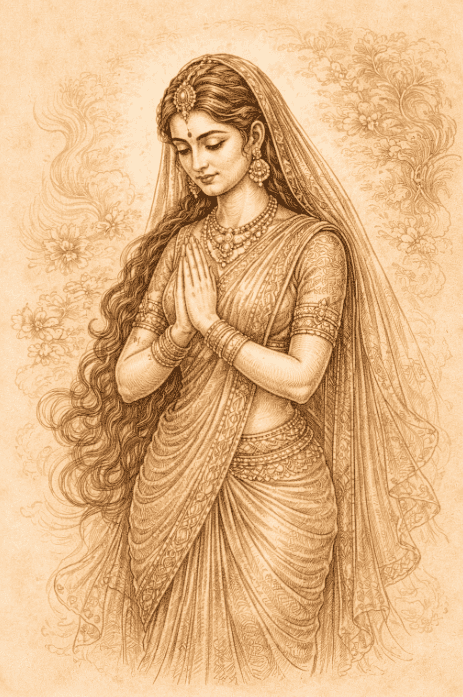
In the vast tapestry of Hindu mythology, few narratives capture the essence of divine intervention and cosmic purpose as profoundly as the birth of Sati. As the embodiment of Adi Parashakti, the primordial cosmic energy, Sati’s incarnation represents a pivotal moment in the eternal cycle of creation, preservation, and destruction. This article explores the divine origins of Sati, her deliberate choice to manifest as the youngest daughter of Daksha, and the inherent qualities of purity, beauty, and spiritual power that defined her from the moment of birth. Drawing from ancient scriptures such as the Shiva Purana and the Devi Bhagavata Purana, we delve into the facts surrounding this event, highlighting its spiritual significance and the boon granted by Adi Parashakti herself.
The story of Sati is not merely a tale of birth but a testament to the goddess’s sovereignty over the universe. Adi Parashakti, often revered as the supreme feminine force, transcends all forms and manifestations. Her decision to incarnate as Sati underscores the interplay between the divine and the mortal realms, where even gods like Brahma and Daksha become instruments in her grand design. Through this exploration, we aim to provide a clear understanding of how Sati’s birth fulfilled a cosmic boon and embodied qualities that would shape her destiny as the consort of Lord Shiva.
Article Structure
The Cosmic Context: Adi Parashakti’s Role in the Universe
To comprehend Sati’s divine birth, one must first appreciate the foundational role of Adi Parashakti in Hindu cosmology. Adi Parashakti is described in the Puranas as the eternal, formless energy from which all creation emerges. She is the source of the Trimurti, Brahma the creator, Vishnu the preserver, and Shiva the destroyer, and exists beyond time and space. In texts like the Lalita Sahasranama, she is praised as “Adi Shakti,” the primal power that animates the cosmos.
According to mythological accounts, the universe undergoes cycles of creation and dissolution, known as kalpas. In one such cycle, the need arose for Adi Parashakti to manifest in a form that could bridge the divine and earthly planes. This manifestation was not arbitrary; it was a deliberate act to restore balance and fulfill devotional aspirations. The Shiva Purana narrates that before Sati’s birth, the gods faced challenges in maintaining dharma, and Shiva, in his ascetic form, remained detached from worldly affairs. Adi Parashakti’s choice to incarnate as Sati was thus a strategic intervention to draw Shiva back into the cycle of creation through marital union.
This cosmic context sets the stage for understanding the boon that preceded Sati’s birth. Daksha, a son of Brahma and a prominent Prajapati (progenitor of beings), played a central role in this narrative. As a devout follower of Vedic rituals, Daksha sought to expand his lineage and contribute to the propagation of life. However, his story intertwines with the divine when Adi Parashakti herself grants him a boon, promising to be born as his daughter. This boon was not merely a gift but a fulfillment of Daksha’s penance and a step in the goddess’s eternal plan.
Daksha’s Penance and the Boon from Adi Parashakti
The factual foundation of Sati’s birth lies in Daksha’s rigorous ascetic practices. As detailed in the Brahma Purana and Shiva Purana, Daksha performed intense tapas (austerities) to please the supreme deity. His devotion was unwavering, involving meditation, fasting, and adherence to Vedic principles. In recognition of his efforts, Adi Parashakti appeared before him in her radiant form, illuminating the heavens with her divine light.
The boon granted was explicit and profound: Adi Parashakti declared that she would incarnate as Daksha’s youngest daughter. This promise is recorded in scriptural verses, emphasizing the goddess’s autonomy. She stated, “I shall be born as your daughter, O Daksha, to fulfill the cosmic order and unite with Mahadeva.” This boon carried conditions reflective of her divine nature, she would retain her purity and spiritual essence, unbound by mortal limitations.
Daksha’s reaction to this boon was one of profound gratitude and awe. As a Prajapati, he already had numerous daughters, but the prospect of fathering the goddess herself elevated his status in the divine hierarchy. This event underscores a key fact in Hindu mythology: boons from deities are often instruments of larger cosmic purposes. In this case, the boon ensured that Sati would grow up in an environment steeped in Vedic knowledge, preparing her for her role as Shiva’s consort.
The boon also highlights Adi Parashakti’s compassion. By choosing Daksha, she honored his devotion while advancing the narrative of divine love. This act of grace is a recurring theme in Puranic literature, where gods reward sincere penance with extraordinary outcomes. For instance, similar boons are seen in the stories of Parvati’s birth to Himalaya or Lakshmi’s incarnation as Padmavati.
The Miraculous Conception and Birth of Sati
Sati’s conception and birth were marked by celestial omens, affirming her divine origin. According to the Devi Bhagavata Purana, Prasuti, Daksha’s wife and a embodiment of maternal virtue, experienced visions during her pregnancy. The fetus radiated an inner light, symbolizing the goddess’s presence. Astrological alignments and divine music filled the air, as narrated in ancient texts, indicating that this was no ordinary birth.
When Sati was born, the event was accompanied by auspicious signs. Flowers rained from the skies, and the gods assembled to bless the newborn. Scriptural accounts describe her as emerging with a halo of divine energy, her skin glowing like molten gold. From the moment of her birth, Sati exhibited qualities that set her apart: unparalleled purity, ethereal beauty, and innate spiritual power.
Purity was foremost among her attributes. In Hindu philosophy, purity (shuddhi) represents freedom from ego and attachment. Sati’s purity was inherent, derived directly from Adi Parashakti’s essence. She was untouched by the illusions of maya, allowing her to perceive the ultimate truth from infancy. This quality is factual in the sense that mythological texts portray her as engaging in devotional practices even as a child, meditating on Shiva without external prompting.
Beauty, another defining trait, was not superficial but a reflection of her divine harmony. The Puranas describe her as “the most beautiful among women,” with eyes like lotuses and a form that captivated all beings. This beauty symbolized the allure of the divine feminine, drawing devotees toward spiritual enlightenment. It was a boon from Adi Parashakti, ensuring that Sati’s physical form mirrored her inner radiance.
Spiritual power completed the triad of her qualities. Sati possessed siddhis (supernatural abilities) from birth, such as clairvoyance and the ability to influence cosmic events. These powers stemmed from her identity as Adi Parashakti, enabling her to navigate the complexities of her destiny. For example, even as a young girl, she demonstrated wisdom beyond her years, advising her father on matters of dharma.
Inherent Qualities: Purity as the Foundation of Divinity
Delving deeper into Sati’s purity, this quality is central to her narrative and serves as a model for spiritual aspirants. In the context of her birth, purity manifested as an unblemished soul, free from karmic debts. The Shiva Purana states that Sati was born without the taint of previous lives, a direct result of Adi Parashakti’s boon. This allowed her to embody sattva guna, the mode of goodness, predominantly.
Purity also influenced her relationships. As Daksha’s beloved youngest daughter, she was cherished for her gentle demeanor and unwavering devotion. Daksha, despite his later flaws, initially doted on her, recognizing her as a divine gift. This familial bond highlights how purity fosters harmony, even in divine households.
Symbolically, Sati’s purity represents the uncorrupted aspect of the universe. In Tantric traditions, she is associated with the muladhara chakra, grounding spiritual energy in purity. This factual linkage in esoteric texts underscores her role in elevating human consciousness.
Beauty: A Manifestation of Divine Grace
Sati’s beauty, bestowed through the boon, was multifaceted. Physically, she possessed features that evoked comparisons to celestial beings: long, flowing hair like midnight silk, a complexion fairer than the moon, and a smile that dispelled darkness. These descriptions in the Puranas are not poetic exaggerations but factual elements that emphasize her divine allure.
Beyond the physical, her beauty encompassed inner grace. It attracted not only mortals but also deities, including Shiva, who was initially indifferent to worldly beauty. The boon ensured that her beauty served a higher purpose, to facilitate the union of Shakti and Shiva, symbolizing the integration of energy and consciousness.
In cultural contexts, Sati’s beauty inspires art and literature. Temples dedicated to her, such as those in the Shakti Peethas, often depict her form with emphasis on aesthetic perfection, reminding devotees of the divine’s inherent beauty.
Spiritual Power: The Essence of Adi Parashakti
Sati’s spiritual power was evident from birth, manifesting as an aura of authority and wisdom. The Devi Purana recounts instances where infant Sati calmed storms with her gaze or revealed hidden truths to sages. This power was a direct inheritance from Adi Parashakti, who embodies all shaktis (powers).
Factually, her spiritual prowess enabled her to choose her path consciously. Unlike ordinary beings, Sati was aware of her divine mission, to marry Shiva and restore cosmic balance. This awareness stemmed from the boon, which preserved her eternal knowledge.
Her power also extended to yogic practices. As a child, she mastered asanas and pranayama effortlessly, preparing for her tapas to win Shiva. This aspect highlights the boon’s role in equipping her with tools for spiritual fulfillment.
Sati’s Childhood and Early Manifestations of Divinity
Growing up in Daksha’s household, Sati’s divine qualities shone brightly. Surrounded by her sisters, she stood out as the epitome of virtue. Scriptural narratives describe her engaging in playful yet profound activities, such as creating sand lingams for Shiva worship. These acts were early indicators of her devotion.
Daksha, honoring the boon, provided her with the best education in Vedas and arts. However, Sati’s innate wisdom surpassed formal learning, often correcting elders on subtle points of philosophy. This intellectual prowess, combined with her purity, made her a beacon of inspiration.
One notable episode from her childhood involves a vision of Shiva. As per the Shiva Purana, young Sati meditated and beheld Shiva in his meditative form, solidifying her resolve. This event factualizes her spiritual power, showing how Adi Parashakti’s essence guided her from within.
The Symbolic Significance of Sati’s Birth
Beyond the literal facts, Sati’s birth carries deep symbolism. It represents the descent of the divine into the material world, a theme echoed in avatars like Rama and Krishna. The boon from Adi Parashakti symbolizes grace bestowed upon the deserving, encouraging devotees to pursue tapas.
Her qualities, purity, beauty, and power, symbolize the triple aspects of the goddess: Iccha Shakti (will), Jnana Shakti (knowledge), and Kriya Shakti (action). This trinity underscores her role in cosmic dynamics.
In modern interpretations, Sati’s story inspires empowerment. Her choice to incarnate highlights agency, reminding us that divine energy resides within all.
Challenges and Foreshadowing in Sati’s Life
While her birth was auspicious, Sati’s life foreshadowed trials. Daksha’s growing ego, as noted in texts, would later lead to conflict. Yet, her inherent qualities equipped her to face these, culminating in her self-immolation, a act of ultimate purity.
This foreshadowing adds depth to her narrative, showing how divine boons encompass both joy and sacrifice.
Legacy of Sati: From Birth to Eternal Worship
Sati’s divine birth laid the foundation for her legacy as Parvati’s predecessor. After her sacrifice, Adi Parashakti reincarnated as Parvati, continuing the cycle. The Shakti Peethas, sites where her body parts fell, are factual testaments to her enduring power.
Today, festivals like Navratri celebrate her qualities, invoking purity and strength.
Embracing the Divine Within
In summarizing Sati’s divine birth, we recognize it as a masterful orchestration by Adi Parashakti. Through the boon to Daksha, she manifested with purity, beauty, and spiritual power, fulfilling cosmic purposes. This narrative invites reflection on our own potential for divinity.