
Article Structure
Introduction to the Persistent Conflict
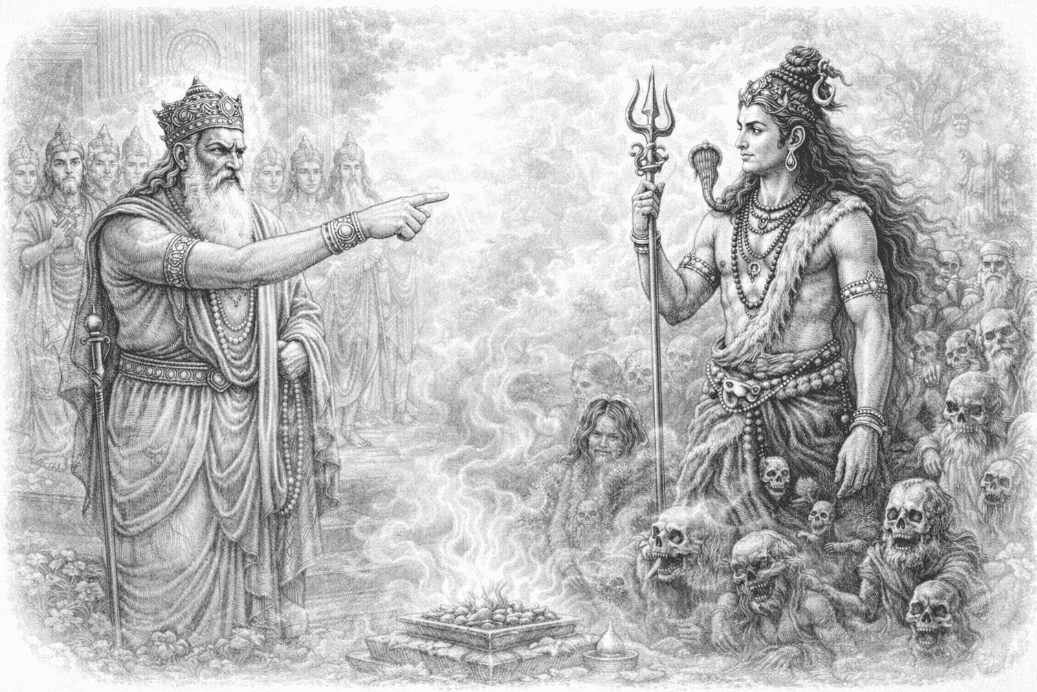
In Hindu mythology, the relationship between Daksha Prajapati and Lord Shiva exemplifies a profound clash between worldly values and transcendent spirituality. Daksha, a prominent son of Brahma and a key figure among the Prajapatis responsible for creation and propagation, remained steadfast in his disapproval of Shiva long after the marriage to his daughter Sati took place. Despite the divine union sanctioned by celestial intervention and Sati’s unwavering devotion, Daksha continued to view Shiva as an unworthy son-in-law.
Puranic sources, including the Shiva Purana, Bhagavata Purana, and Linga Purana, consistently attribute Daksha’s rejection to Shiva’s ascetic lifestyle, unconventional appearance, and perceived lack of alignment with societal and ritual norms.
This article examines these reasons in detail, drawing from scriptural accounts to provide a clear understanding of the underlying tensions. The focus remains on Daksha’s perspective as portrayed in the texts, illustrating how personal pride, cultural expectations, and differing worldviews fueled his ongoing opposition.
Daksha’s Worldview: A Life Rooted in Vedic Order and Royalty
Daksha embodied the ideals of Vedic ritualism, social hierarchy, and royal responsibility. As a Prajapati appointed by Brahma, he prioritized the maintenance of cosmic order through yajnas (sacrificial rites), alliances, and the propagation of life. His status as a king-like figure among the progenitors involved strategic marriages for his daughters to enhance influence and uphold dharma in worldly terms.
In this framework, a suitable son-in-law would represent prestige, adherence to social conventions, and active participation in rituals. Shiva, however, presented a stark contrast. The Puranas describe Daksha’s initial reluctance during Sati’s swayamvara and his continued dissatisfaction post-marriage as stemming from a fundamental mismatch in values. This mismatch persisted, intensifying Daksha’s rejection even after the ceremony.
Shiva’s Ascetic Lifestyle: A Primary Source of Disapproval
Central to Daksha’s opposition was Shiva’s commitment to asceticism. Shiva is depicted in the Shiva Purana and Bhagavata Purana as the supreme yogi, residing in the Himalayas, immersed in meditation, and detached from worldly pursuits. He smeared his body with ashes, wore minimal clothing such as tiger or elephant skin, and lived in simplicity without concern for material comforts or social engagements.
Daksha, accustomed to royal splendor and ritual grandeur, found this lifestyle incomprehensible and inappropriate for a family member. Accounts note that Shiva’s renunciation of worldly duties clashed with Daksha’s expectations of a groom who would contribute to alliances and participate in societal functions. Shiva’s detachment was seen as a rejection of the very order Daksha upheld through yajnas and progeny.
Furthermore, Shiva’s association with cremation grounds and his transcendence of conventional life cycles reinforced Daksha’s view that such a figure did not belong in a household oriented toward creation and prosperity. This ascetic path, while spiritually exalted, appeared to Daksha as a form of withdrawal incompatible with familial and social responsibilities.
Unconventional Appearance: Perceived as Inauspicious and Unfitting
Shiva’s physical appearance further deepened Daksha’s aversion. The Puranas describe Shiva with matted locks (jata), a crescent moon adorning his head, the Ganges flowing from his hair, serpents coiled around his neck and arms, ashes covering his body, and a third eye on his forehead. He carried a trident and drum, symbols of his roles as destroyer and cosmic dancer.
To Daksha, these attributes symbolized inauspiciousness and irregularity. Ashes from cremation grounds evoked death rather than life, serpents suggested danger and impurity, and the overall form deviated from the polished, adorned appearance expected of deities or royals in Vedic society. The Bhagavata Purana and related texts indicate that Daksha regarded Shiva’s look as “odd” and “strange,” unfit for integration into a cultured, ritualistic family.
This judgment reflected broader cultural norms where external form often signified inner propriety. Daksha’s royal background led him to equate propriety with conventional beauty and adornment, making Shiva’s unconventionality a constant source of irritation.
Perceived Unworthiness: Ego, Insult, and Social Hierarchy
Beyond lifestyle and appearance, Daksha perceived Shiva as unworthy due to perceived slights and hierarchical considerations. In one key incident described in the Shiva Purana and Bhagavata Purana, during a grand yajna conducted by Brahma or another assembly, Daksha entered late. All present rose in respect except Brahma (his father) and Shiva. Daksha interpreted Shiva’s non-rising as disrespect, especially since Shiva was now his son-in-law.
This event escalated Daksha’s resentment. He viewed Shiva as subordinate, almost a disciple, due to the marriage, yet Shiva’s supreme status and detachment prevented conventional deference. Daksha’s pride as a Prajapati and ritual authority clashed with Shiva’s transcendence, leading to accusations of discourtesy and irreligion.
Additionally, Shiva’s ganas, followers including ghosts, goblins, and other unconventional beings, further diminished his perceived worthiness in Daksha’s eyes. These attendants contrasted sharply with the refined assemblies of gods and sages Daksha valued. The marriage, forced by Sati’s choice and divine pressure, only intensified Daksha’s sense of insult, as it bound him to a figure he deemed unsuitable for alliances or respect.
The Culmination in the Great Yajna: Rejection Manifested
Daksha’s persistent rejection reached its peak in the organization of a grand yajna (often called Brihaspatistava in the Bhagavata Purana). He invited all deities, Prajapatis, and kings but deliberately excluded Shiva and Sati. This omission was a deliberate act to insult Shiva and assert his own authority.
The Shiva Purana and other texts explain that Daksha’s motive was rooted in the accumulated grievances: Shiva’s asceticism, appearance, perceived disrespect, and overall unworthiness. By excluding them, Daksha sought to exclude Shiva from ritual shares (havis) and public honor, reinforcing his view that Shiva did not merit inclusion in Vedic society.
Sati’s decision to attend uninvited, followed by the tragic events, stemmed directly from this rejection. Daksha’s words and actions during the yajna, publicly denigrating Shiva, reflected his unchanged stance, even after the marriage.
Symbolic and Philosophical Dimensions
Daksha’s opposition carries deeper symbolic meaning in Puranic literature. It represents the tension between worldly dharma (ritual, society, creation) and transcendental moksha (detachment, ultimate reality). Daksha’s ego-driven rejection highlights how pride blinds one to divine truth, while Shiva’s equanimity demonstrates supreme indifference to worldly judgment.
The narrative also underscores themes of acceptance and transformation. Daksha’s eventual fate, his destruction and revival, serves as a lesson in humility and recognition of Shiva’s supremacy.
Lessons from Daksha’s Rejection
The story offers insights into human tendencies: attachment to external forms, social status, and ritual propriety can obscure deeper spiritual realities. Daksha’s refusal to accept Shiva post-marriage illustrates how preconceptions hinder harmony.
For devotees, it reinforces Shiva’s transcendence, worthy of worship beyond appearances, and the importance of inner devotion over external judgment.
Conclusion: A Conflict Rooted in Perception, Not Circumstance
Daksha’s outright rejection of Shiva as his son-in-law, even after the sacred marriage, arose from Shiva’s ascetic lifestyle, unconventional appearance, and perceived unworthiness in social and ritual terms. Puranic accounts portray these as products of Daksha’s pride, Vedic worldview, and personal grievances.
This enduring conflict, detailed across major scriptures, culminates in profound events that affirm divine order while cautioning against ego and superficial judgment. The narrative remains a timeless exploration of devotion, acceptance, and the clash between worldly and spiritual realms.