
Article Structure
A Fundamental Divide Between Transcendence and Ritual Order
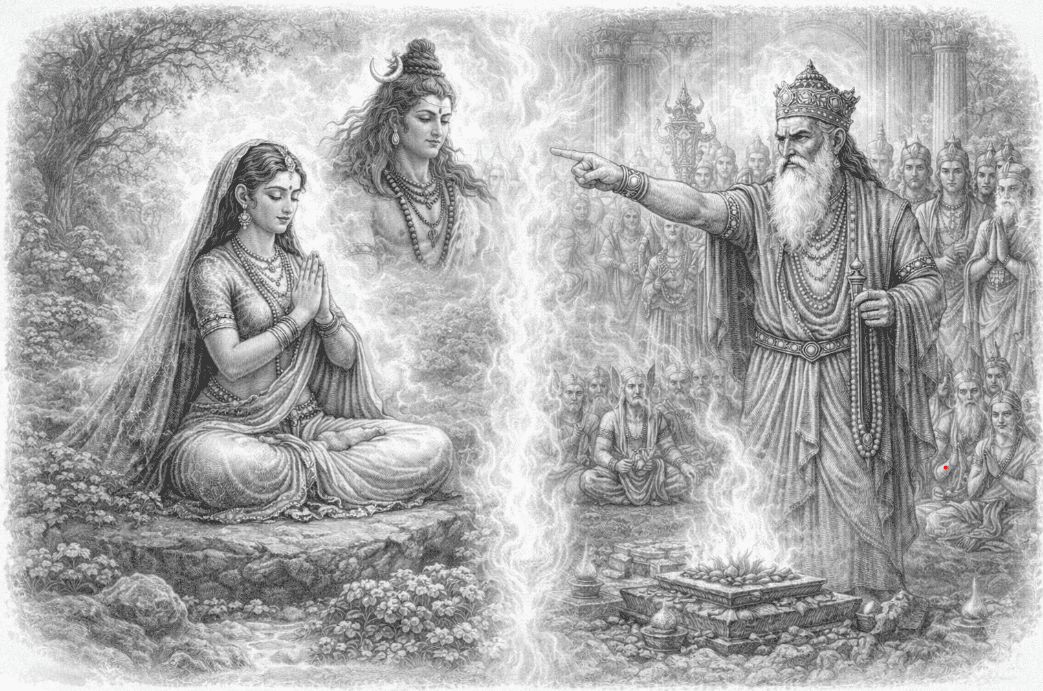
In Hindu Puranic literature, the relationship between Goddess Sati and her father Daksha Prajapati illustrates one of the most striking contrasts in spiritual outlook. Sati, as the incarnation of Adi Parashakti, embodied pure bhakti, unconditional devotion, inner detachment, and transcendence beyond worldly forms. Daksha, a foremost Prajapati and son of Brahma, represented the material and ritualistic order: meticulous adherence to Vedic sacrifices, emphasis on progeny, social hierarchy, and the propagation of dharma through structured action in the world.
This fundamental difference in perspective, transcendence versus ritualistic engagement, runs through the entire narrative arc of their story. Ancient texts, including the Shiva Purana, Bhagavata Purana, Devi Bhagavata Purana, and Linga Purana, consistently highlight how Sati’s path of loving surrender clashed with Daksha’s framework of duty, status, and cosmic maintenance through Yagya. The contrast is not merely personal but symbolic of two legitimate yet distinct approaches to the divine within Hindu thought.
This article examines the key dimensions of this opposition, drawing directly from Puranic descriptions to present a clear, factual comparison. It explores Sati’s embodiment of bhakti and vairagya (detachment) alongside Daksha’s commitment to Vedic ritual, lineage, and hierarchical order, revealing lessons about the diversity of spiritual paths.
Sati’s Path: The Essence of Pure Bhakti
From her earliest days, Sati displayed an innate orientation toward bhakti, the path of loving devotion that seeks union with the divine through complete surrender. The Shiva Purana notes that even as a child she was captivated by stories of Lord Shiva, internalizing them not as distant legends but as living truth. Her devotion was spontaneous, unmediated by external rules, and directed solely toward Shiva as the supreme reality.
This bhakti manifested as:
- Inner detachment (vairagya): Sati showed little interest in palace luxuries, royal alliances, or sensory pleasures. She preferred solitude for contemplation and willingly left comforts behind to perform tapas in the forest.
- Single-pointed focus: Her austerities, fasting, meditation, yogic discipline, were offered exclusively to win Shiva’s heart, not to gain power, status, or progeny.
- Transcendence of form: Sati recognized Shiva beyond his unconventional appearance (ashes, serpents, matted hair). Her love pierced external judgments, seeing only the eternal consciousness within.
In the Devi Bhagavata Purana and related texts, Sati’s devotion is portrayed as the highest form of yoga, direct communion through love rather than ritual performance. Her ultimate act at Daksha’s Yagya, self-immolation through yogic power to protect Shiva’s honor, stands as the pinnacle of such surrender, transcending even bodily existence.
Daksha’s Worldview: The Primacy of Vedic Ritual and Order
Daksha, by contrast, operated within the paradigm of karma-kanda, the ritualistic portion of the Vedas that emphasizes action, sacrifice, and maintenance of cosmic and social order. As a Prajapati tasked with creation and propagation, his life revolved around:
- Yagya as central duty: Daksha conducted grand sacrifices to sustain the universe, distribute offerings to deities, and uphold dharma. The Bhagavata Purana describes his assemblies filled with ritually pure Brahmins, precise mantras, and elaborate preparations.
- Progeny and lineage: He fathered numerous daughters to form alliances among gods, sages, and celestial beings, viewing marriage as a means to expand creation and strengthen cosmic structure.
- Hierarchical order: Status, propriety, and respect for Vedic norms governed his judgments. He expected deities to conform to social etiquette, rise in assemblies, and participate in ritual reciprocity.
In this framework, worthiness was measured by visible adherence to rules, appearance, conduct, ritual participation, rather than inner realization. Shiva’s detachment from these norms appeared to Daksha as rejection of dharma itself.
Key Points of Contrast – When Bhakti and Ritual Collide
1. Goal and Orientation
- Sati: Union with the divine through love and surrender; ultimate aim was transcendence (mokṣa through bhakti).
- Daksha: Maintenance of cosmic order through action; ultimate aim was preservation of the manifested world (srsti-sthiti through karma).
2. Attitude Toward the World
- Sati: The world is transient (maya); true reality lies beyond form. She detached naturally from material pursuits.
- Daksha: The world is the field of dharma; ritual action within it is sacred duty. He invested deeply in social and material structures.
3. View of Ritual
- Sati: External rites were secondary; inner devotion sufficed. Her tapas and worship were personal and direct.
- Daksha: Ritual was primary; precise performance of Yagya ensured cosmic harmony. He judged others by their participation or non-participation.
4. Perception of Shiva
- Sati: Saw the supreme beyond appearance, pure consciousness worthy of absolute love.
- Daksha: Saw an ascetic who rejected Vedic norms, appeared inauspicious, and failed to show expected deference.
5. Response to Conflict
- Sati: Maintained equanimity and devotion even under opposition; chose self-sacrifice over compromise of principle.
- Daksha: Responded with resentment and exclusion, culminating in the deliberate insult at his grand Yagya.
These contrasts are not presented in the Puranas as a simple right-wrong dichotomy but as two poles within the broader Hindu framework: pravṛtti (active engagement in the world) versus nivṛtti (withdrawal for transcendence).
The Tragic Culmination at the Yagya
The sharpest expression of this divide occurred during Daksha’s great sacrifice. Inviting all deities except Shiva and Sati, Daksha excluded them from ritual shares, publicly denigrated Shiva, and upheld his vision of order. Sati, driven by bhakti, attended to defend her husband’s honor, only to face humiliation. Her self-immolation, transforming her body into yogic fire, symbolized the ultimate transcendence of material limitations, while Daksha’s ritual world crumbled in the face of Shiva’s wrath.
This event underscores the Puranic message: while ritual sustains the manifested cosmos, unalloyed devotion can pierce through illusion and reach the absolute.
The Contrast Between Sati’s Pure Love and Daksha’s Ritual Order
The contrast between Sati and Daksha represents enduring tensions in spiritual life:
- Bhakti versus karma-kanda
- Inner realization versus external performance
- Transcendence versus immanence
- Love beyond form versus duty within form
Later traditions reconciled these poles: Shaivism integrated ritual with devotion, while Vedanta affirmed both paths as valid according to temperament.
Cosmic Lesson
The narrative invites reflection on personal spiritual orientation. Does one prioritize structured practice and social duty, or direct, heartfelt surrender? Both approaches hold validity, yet the Puranas affirm that when ritual becomes rigid and prideful, it may obscure the divine truth that pure devotion reveals.
Sati’s example encourages cultivating bhakti that transcends judgment, while Daksha’s story cautions against allowing ego to rigidify religious forms.
Two Complementary Yet Contrasting Visions
Sati’s pure devotion and Daksha’s ritualistic order represent two authentic expressions of dharma, one inward and transcendent, the other outward and preservative. Their sharp contrast, meticulously depicted across major Puranas, enriches our understanding of the multifaceted nature of the spiritual path.
By appreciating both perspectives without reducing one to the other, devotees gain deeper insight into the harmony that ultimately exists between bhakti and karma, love and duty, transcendence and engagement in the divine play of existence.