
Introduction: A Peaceful Abode Suddenly Disturbed
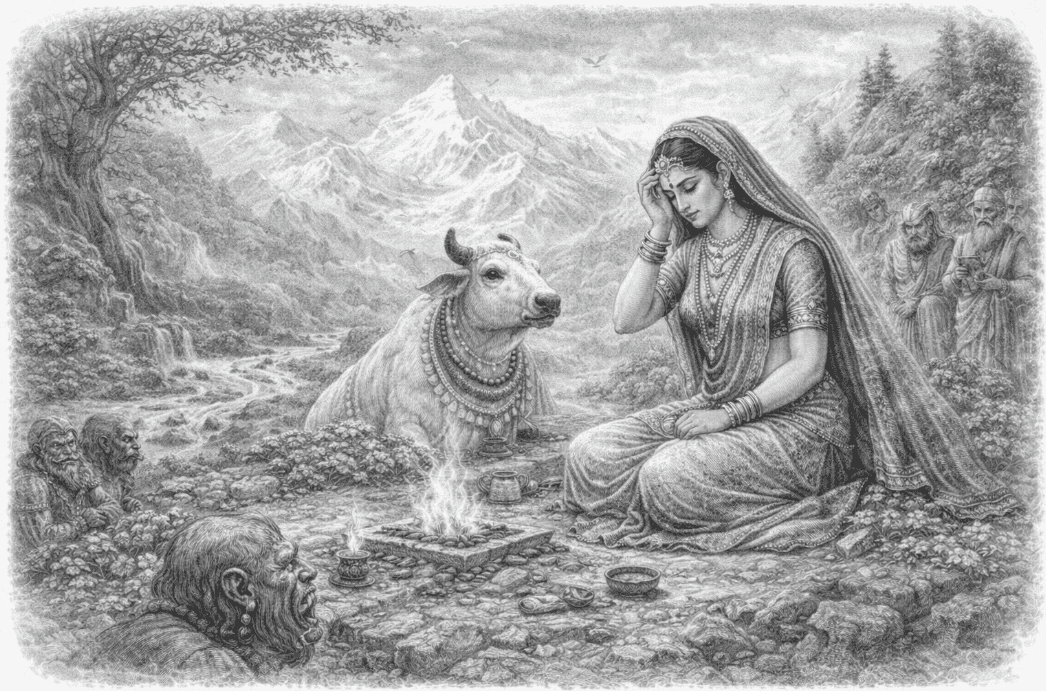
In Shiva Purana, Bhagavata Purana, and Devi Bhagavata Purana, the life of Goddess Sati on Mount Kailasa is portrayed as a model of quiet harmony between intense spiritual practice and gentle domestic affection. After her marriage to Lord Shiva, Sati had chosen a life of simplicity and devotion far removed from the royal splendor of her father Daksha’s palace. She served Shiva with complete dedication, participated in his meditative silence, and maintained the modest household with natural grace. The mountain abode, surrounded by eternal snow and sacred lakes, reflected the inner calm of its divine residents.
This tranquility was broken by the arrival of news that would forever alter the course of events: the announcement of a grand sacrificial ritual (Yagya) organised by Daksha, from which both Shiva and Sati had been deliberately excluded. The moment Sati became aware of this event marked the beginning of one of the most emotionally intense episodes in Puranic literature, a profound inner conflict between two powerful forms of dharma: the duty owed to one’s father and the devotion owed to one’s divine husband.
This article examines, on the basis of traditional accounts, how the news reached Sati, through which channels it arrived, and how it triggered a deep and painful struggle within her heart between familial obligation and unshakeable bhakti toward Shiva.
The Tranquil Setting on Kailasa Before the News Arrived
Before describing the discovery itself, it is helpful to recall the environment in which Sati lived. Mount Kailasa is repeatedly described in the Shiva Purana as the cosmic centre, a place where time seems to slow and where the boundary between the material and the transcendent becomes thin. The air is pure, the silence is deep, and the only sounds are the soft flow of mountain streams and the occasional chant of mantras rising from Shiva’s meditation.
Sati’s daily life reflected this serenity. She rose before dawn, prepared simple offerings of bilva leaves, water from the sacred Gaṅga (flowing from Shiva’s matted locks), milk, and wild flowers. She joined Shiva in silent worship, sat near him during his long periods of samadhi, and cared for the ganas, the loyal attendants who formed the small divine community around them. Her devotion was expressed not through elaborate ceremonies but through constant awareness of Shiva’s presence and through small acts of service performed with love.
Although Sati had chosen this life freely, the memory of her father Dakṣa never entirely faded. She still regarded him with the natural affection of a daughter, even though she had witnessed his growing disapproval of Shiva. The tension between her two worlds, the ascetic household of Kailasa and the ritualistic, hierarchical world of her father, existed quietly beneath the surface. Until the day the news of the Yagya arrived, that tension remained largely unspoken.
Different Channels Through Which the News Reached Sati
The Puranas present slight variations in how Sati first learned of her father’s grand sacrifice, but all accounts agree that the information did not arrive in an ordinary, direct manner. Instead, it came through multiple subtle and symbolic channels that underscored the cosmic significance of the event.
1. Celestial omens and disturbances in nature
Several versions describe initial signs that appeared in the natural world around Kailasa. The Shiva Purana notes unusual atmospheric changes: clouds that gathered without rain, a faint reddish tint in the normally clear sky, and birds flying in patterns that resembled ritual formations. These were not random weather events; they were understood as messages from higher realms.
In one detailed account, during her morning worship Sati noticed that the flames in the small fire she maintained for daily offerings began to behave strangely, sometimes leaping high without fuel, sometimes dimming unexpectedly. When she concentrated her awareness, she perceived distant vibrations of Vedic chants carried on the wind. These subtle disturbances were the first indication that a major ritual was taking place somewhere in the three worlds.
2. Reports from the ganas and attendants
The ganas who served Shiva and Sati included beings capable of moving freely between realms. Some were entrusted with observing events in the worlds below. One of these attendants, in certain retellings it is Nandī himself, returned from a journey with grave news. He reported that Dakṣa Prajapati was conducting preparations for an exceptionally large Yagya, inviting all the principal deities, rṣis, and celestial beings. The scale of the event was immense, with vast quantities of offerings being gathered and elaborate altars constructed.
Crucially, the attendant noted that neither Lord Shiva nor Goddess Sati had received any formal invitation. The omission was not accidental; it had been discussed openly in Dakṣa’s court and was understood by all present as a deliberate statement.
3. Indirect communication from Dakṣa’s household
A few versions mention a more personal channel: a messenger or a letter sent from Dakṣa’s palace that reached Kailasa indirectly. In some accounts, one of Sati’s former companions or a neutral intermediary delivered a formal announcement of the Yagya’s date and purpose, perhaps intending only to inform her of her father’s glory. The document listed the invited guests in detail, yet Shiva’s name was conspicuously absent.
Regardless of the exact medium, all sources agree that the news reached Sati through a combination of intuitive perception, loyal informants, and indirect communication, never through a direct, personal invitation from Dakṣa himself.
The Immediate Emotional Impact: Shock and Sorrow
Upon receiving confirmation of the Yagya and the deliberate exclusion, Sati experienced a deep emotional shock. The Shiva Purana describes her first reaction as one of profound sorrow. Tears filled her eyes as she realised the full implication: her father had chosen to perform a public ritual of cosmic importance while pointedly rejecting the presence of her husband, the very person she regarded as the supreme reality.
This sorrow was not merely personal. As an embodiment of Śakti, Sati was acutely aware of the cosmic imbalance created by excluding the destroyer from a rite meant to sustain creation. Yet the dominant feeling at that moment was the pain of a daughter who saw her father publicly dishonouring the one she loved most.
The Deep Inner Conflict: Two Competing Dharmas
The real intensity of the episode begins with Sati’s internal struggle between two powerful dharmic pulls.
1. The call of pitr-dharma (duty toward the father)
As a daughter, Sati had been raised with the Vedic understanding that parents are to be revered almost as deities. Dakṣa had given her life, educated her in the scriptures, and, despite his later opposition, once performed intense tapas to obtain her as his child. The idea of remaining absent from such a significant event in her father’s life felt like a violation of gratitude and respect.
Moreover, Sati recognised the legitimacy of Yagya as a means of sustaining the world. Dakṣa’s sacrifice was not a personal celebration; it was a public act of cosmic maintenance. To stay away might appear as rejection of that sacred responsibility.
2. The supremacy of pati-bhakti (devotion to the husband)
At the same time, Sati’s devotion to Shiva was not an ordinary wifely affection, it was complete spiritual surrender. In the language of the Puranas, she was pativrata in the highest sense: her husband was her god, her path, her liberation. To participate in, or even witness, a ritual that insulted him would mean lending legitimacy to that insult.
She understood that Shiva’s exclusion was not merely social rudeness; it was a philosophical statement that Vedic ritual could proceed without acknowledging the transcendent reality he represented. Attending would place her in the position of silently endorsing that statement.
The Inner Dialogue: Weighing Honour, Curiosity, and Fear
The Puranas present Sati’s mind as engaged in a silent but intense dialogue. On one side were thoughts of honour and curiosity: “I wish to see my father’s greatness with my own eyes. Perhaps my presence will soften his heart. Perhaps I can prevent greater dishonour.” On the other side stood fear and conviction: “If I go, I will witness my husband being insulted in public. If I remain silent, I become complicit. If I speak, I dishonour my father in his own assembly.”
This inner debate lasted for some time. Sati did not reach a quick decision. She withdrew into deeper contemplation, seeking clarity from within. In moments of stillness, she experienced the presence of Adi Parashakti, her own original nature, reminding her that true dharma is never in conflict with itself when guided by pure love and truth.
The Turning Point: From Turmoil Toward Resolve
Although the Shiva Purana does not describe the exact moment of final decision in elaborate detail, it makes clear that devotion ultimately prevailed, not by suppressing filial feeling, but by integrating it into a higher understanding. Sati concluded that she must go to the Yagya, not to participate as a guest, but to bear witness to truth and, if necessary, to defend the honour of the one she recognised as supreme.
This decision did not eliminate her pain; it transformed it. She accepted that going might bring suffering, but she also understood that remaining silent in Kailasa would cause a different kind of suffering, the pain of inaction in the face of adharma.
Conclusion: A Universal Human and Divine Dilemma
Sati’s discovery of the Yagya through celestial signs, loyal attendants, and indirect messages plunged her into one of the most poignant moments of inner conflict in all of Puranic literature. Caught between the natural love and duty owed to her father and the absolute devotion owed to her divine husband, she embodied the universal human experience of divided loyalties.
Her struggle teaches that dharma is rarely simple. Sometimes the highest path requires choosing between two goods, each legitimate in its own sphere. Sati’s turmoil, and the courage with which she eventually moved forward, reminds every reader that genuine devotion is tested most severely not in moments of ease, but in moments when love and duty appear to pull in opposite directions.