
Article Structure
When the Infinite Forced a Choice
The Lingodbhava episode, described in texts such as the Shiva Purana and Linga Purana, is often remembered for the appearance of the infinite pillar of light. Yet the deeper significance of this event does not lie in the pillar itself, but in how Vishnu and Brahma respond to what cannot be measured.
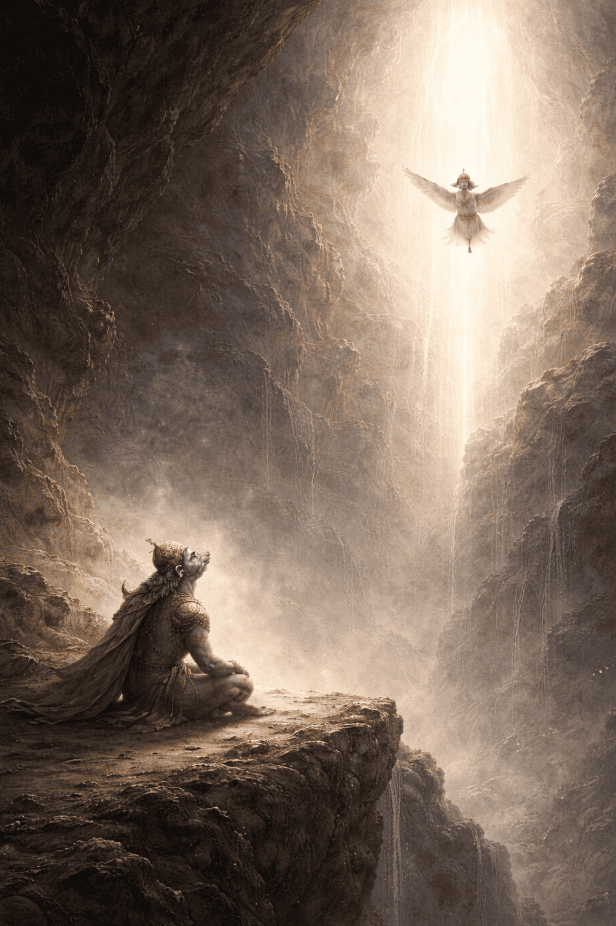
The jyotirlinga presents both deities with the same challenge: to locate its end. Vishnu descends as Varaha, Brahma ascends as a swan, and both encounter the same reality. The pillar has no limit. What follows is not a contest of power, but a divergence in judgment, restraint, and truthfulness.
What Happened After the Search Ended
Vishnu returns from his descent and openly acknowledges failure. He does not locate the base of the pillar and states this plainly. Brahma returns later, claiming success and supporting his assertion with external testimony.
Shiva’s emergence from the pillar resolves the dispute, but the ethical contrast between the two choices remains. The story is not about who searched longer or farther. It is about why one stopped and the other did not.
Vishnu’s Withdrawal and the Ethics of Knowing Limits
Vishnu’s decision to stop searching is grounded in epistemic humility, the recognition that some realities lie beyond the reach of inquiry. His descent is exhaustive. He explores every realm available to him, not out of reluctance, but with full commitment. When the search yields no boundary, he does not force an answer.
In Hindu ethical thought, this restraint reflects viveka, discernment guided by truth. Vishnu’s response aligns with sattva, the quality associated with clarity and balance. He chooses accuracy over assertion, preserving the integrity of inquiry itself.
Stopping, in this context, is not failure. It is an acknowledgment that truth does not always arrive in the form of completion.
Why Persistence Becomes Error in Brahma’s Case
Brahma’s refusal to halt mirrors Vishnu’s effort but diverges in intention. Faced with the same endless reality, Brahma continues upward, driven by the need to affirm primacy. When no summit appears, he seeks validation rather than truth.
This moment exposes the ethical risk of ambition untampered by limitation. In Hindu thought, ambition has a legitimate place within creation and action. However, when it overrides discernment, it shifts from creative impulse to misrepresentation.
The error here is not exploration itself, but the refusal to accept what exploration reveals.
Truth Over Outcome
A recurring principle across Hindu traditions is that truth supersedes achievement. Outcomes do not justify distortion. Vishnu’s choice reflects this principle clearly. He reports what is encountered, not what is desired.
This emphasis appears elsewhere in Hindu narratives. King Harishchandra’s commitment to truth persists even when it leads to suffering. Yudhishthira’s struggles in the Mahabharata reveal how adherence to action without discernment can blur ethical clarity. Arjuna’s hesitation on the battlefield demonstrates that pausing can be the gateway to deeper understanding.
Vishnu’s withdrawal belongs to this ethical lineage. It is a pause that respects reality rather than forcing resolution.
Character Orientation and Cosmic Roles – How Their Roles Shaped Their Decisions
The contrast between Vishnu and Brahma also reflects their cosmic dispositions.
Vishnu, as preserver, embodies adaptability and balance. His response maintains harmony by accepting uncertainty without distortion. Brahma, as creator, embodies generative force and definition. This impulse is essential within finite creation, but becomes unstable when applied to the infinite.
The story does not condemn Brahma’s role. It illustrates its limitation.
Why Stopping Is Praised as Wisdom
In philosophical terms, Vishnu’s choice aligns with jnana, the understanding that wisdom includes knowing when inquiry must end. Certain truths are not reached through pursuit, but through recognition of the limits of pursuit.
This insight appears across Indian philosophical traditions. In Shaiva contexts, it reinforces the idea that the infinite cannot be approached through extension or conquest. Acceptance becomes the higher form of knowledge.
The Lesson That Outlived the Story
The Lingodbhava episode ultimately reframes decision-making itself. It asks whether persistence is always virtuous, or whether wisdom sometimes requires restraint.
Through Vishnu’s example, Hindu thought affirms that humility in the face of the unknowable preserves truth. Brahma’s refusal serves as a caution, not against effort, but against ambition divorced from discernment.
When confronted with infinity, the tradition suggests, wisdom lies not in reaching the end, but in recognizing that there is none.