
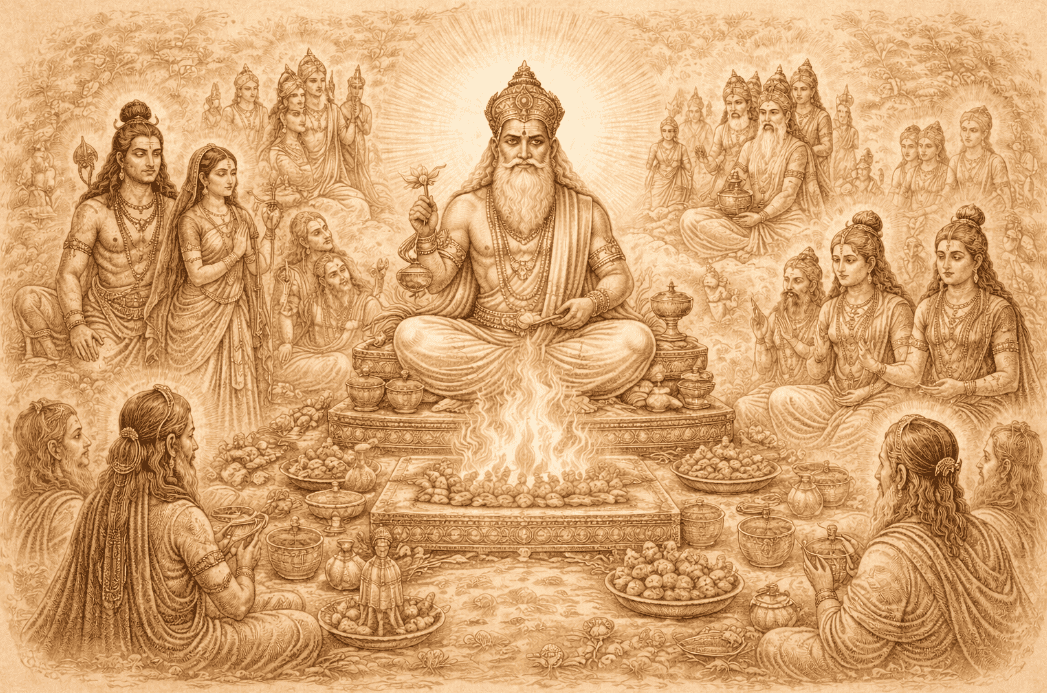
Daksha Prajapati occupies a unique position in Hindu cosmology. As a mind-born son of Brahma and one of the foremost Prajapatis, he was entrusted with transforming creation from abstract potential into a populated, orderly universe. Through lineage, ritual authority, and social hierarchy, Dakṣa became indispensable to cosmic expansion.
Yet the same qualities that elevated him gradually hardened into pride. Over time, this pride turned into open hostility toward ascetic ideals and deep contempt for Śiva, whose way of existence challenged everything Dakṣha stood for. The roots of this conflict lie not in a single insult, but in a steady accumulation of perceived threats to authority, order, and status.
Article Structure
Daksha’s Esteemed Position: The Seeds of Pride
Daksa Prajapati’s origins provided a strong foundation for his sense of superiority. Born directly from Brahma’s mind, or, in some accounts, from his right thumb, he carried the inherent authority of a Prajapati, one tasked with propagating life across realms. His name, meaning “able,” “skillful,” or “expert,” reflected his proficiency in creation and ritual performance. In the Vedic tradition, Daksa symbolized priestly expertise and cosmic order, qualities that elevated him among divine beings.
As Brahma delegated the responsibility of expanding creation, Daksa excelled where others faltered. After initial mental creations proved insufficient for multiplication, he received divine aid, such as the wife Asikni from Vishnu, and shifted to physical procreation. This success produced thousands of sons (Haryashvas and Shabalashvas) and dozens of daughters, who became mothers of gods, demons, sages, and celestial entities. His daughters’ strategic marriages, to figures like Kashyapa, Dharma, Chandra, and others, created vast alliances, reinforcing his influence over divine and mortal affairs.
This unparalleled success fostered a growing sense of pride. Daksa viewed himself as indispensable to cosmic harmony, a royal figure upholding Vedic rituals, social norms, and hierarchical order. In Puranic accounts, he embodied the active, ritualistic path of dharma, contrasting sharply with ascetic withdrawal. His accomplishments, populating worlds, organizing grand sacrifices, and commanding respect from deities, nurtured an ego that increasingly saw deviations from his standards as threats to propriety.
The Marriage of Sati: Initial Disapproval of Shiva
The first major spark of Daksha’s contempt arose from his daughter Sati’s unwavering devotion to Shiva. Sati, often described as the youngest or most cherished among his daughters, performed severe austerities to win Shiva as her husband. Despite Daksa’s strong objections, the marriage occurred, sometimes under pressure from Brahma or through Sati’s determined choice in a swayamvara.
Daksa’s opposition stemmed from several interconnected reasons. Shiva, as Rudra, embodied asceticism: residing in cremation grounds, smeared with ashes, adorned with serpents and skulls, and surrounded by ghosts, goblins, and bhutaganas. To Daksa, a proponent of royal dignity and Vedic propriety, this lifestyle appeared unconventional, impure, and unfit for alliance with his prestigious lineage. Shiva’s indifference to societal norms, rituals, and material pursuits clashed with Daksa’s emphasis on structured order and fruitful sacrifices.
In the Shiva Purana and related texts, Daksa perceived Shiva as an outsider, lacking noble birth in the conventional sense, rejecting worldly engagements, and consorting with beings outside civilized society. This view intensified because Shiva represented destruction and transcendence, while Daksa prioritized creation and preservation through progeny and rites. The marriage, though inevitable, left Daksa resentful, viewing it as a stain on his family’s honor and a challenge to his authority as father and progenitor.
The Incident at Brahma’s Yajna: Perceived Disrespect Fuels Ego
A pivotal event accelerated Daksha’s pride into active hostility: an earlier grand sacrifice conducted by Brahma or involving the Prajapatis. In accounts from the Bhagavata Purana and Shiva Purana, Daksa arrived at this assembly with regal splendor. All present rose in respect, except Brahma (his father) and Shiva.
Shiva’s failure to stand symbolized, to Daksa, a deliberate insult. As a Prajapati and son-in-law, Daksa expected deference, especially in a ritual setting where hierarchy mattered. Shiva’s composure and nonchalance, sitting unaffected amid the gathering, struck Daksa as arrogance and disregard for protocol. In response, Daksa publicly rebuked Shiva, criticizing his “shameless” behavior, lack of manners, and association with goblins, declaring him unfit for Vedic honors.
This episode marked a turning point. Daksa felt his status demeaned, interpreting Shiva’s action as a personal affront to his position and the established order. The incident deepened his rejection of asceticism, which he now associated with disrespect and disorder. Followers on both sides exchanged curses, Nandin cursed Daksa and ritualistic Brahmins, while Bhrigu and others retaliated against Shiva’s devotees, further entrenching the divide. Daksa proclaimed that Shiva would receive no share in future sacrifices, solidifying his contempt.
From this moment, Daksa’s pride evolved into a deliberate stance against Shiva’s path. He began to see asceticism not merely as different but as inferior and disruptive to the ritualistic framework he championed.
Growing Pride and Rejection of Ascetic Values
Daksa’s arrogance grew through his unchallenged successes and reinforced social standing. As a divine king-rishi, he organized elaborate yajnas to assert supremacy and maintain cosmic balance via offerings and alliances. Asceticism, exemplified by Shiva’s detachment from worldly rituals and material ties, represented the opposite: renunciation over accumulation, transcendence over propagation.
In Daksa’s worldview, true power lay in active creation, fruitful progeny, and Vedic sacrifices that sustained dharma. Shiva’s ascetic lifestyle, detached from family duties, indifferent to royal etiquette, and focused on meditation and destruction, appeared as escapism or rebellion against order. Daksa’s pride led him to dismiss asceticism as unworthy, unfit for those of high birth or responsibility.
This rejection manifested in subtle ways before the famous yajna: avoiding Shiva in assemblies, discouraging Sati’s devotion, and prioritizing alliances that enhanced status over spiritual depth. His ego blinded him to Shiva’s supreme nature, reducing the destroyer god to an eccentric ascetic unworthy of respect.
The Daksha Yajna: Pride Culminates in Open Contempt
The climax of Daksa’s growing pride occurred with the Brihaspatistava Yajna (or similar grand sacrifice). Intending to insult Shiva, Daksa invited all deities, Prajapatis, kings, and sages, except Shiva and Sati. This deliberate exclusion aimed to humiliate his son-in-law and affirm his own supremacy.
When Sati attended uninvited, Daksa publicly insulted Shiva, calling him impure, unworthy, and ineligible for ritual shares. Overwhelmed by her father’s contempt, Sati immolated herself in the sacrificial fire. Shiva’s wrath followed: he manifested Virabhadra and Bhadrakali, who devastated the yajna, beheading Daksa (later revived with a goat’s head as a symbol of humbled ego).
This event exposed the full extent of Daksa’s pride. His rejection of asceticism and contempt for Shiva stemmed from ego-driven perceptions of hierarchy, propriety, and worthiness. The yajna’s destruction served as divine correction, teaching that true power lies not in ritual dominance or progeny but in recognition of supreme reality.
Lessons from Daksha’s Fall: Pride, Humility, and Divine Balance
Daksa’s journey illustrates how success can breed arrogance when unchecked by humility. His initial disapproval of Shiva’s asceticism grew into contempt through perceived slights, familial conflicts, and rigid adherence to ritual norms. The Puranas portray this as a cautionary tale: pride blinds one to divine truth, leading to downfall.
Yet, redemption emerges. After revival, Daksa acknowledged Shiva’s supremacy, completing the sacrifice with devotion. His story underscores the balance between creation (Daksa’s domain) and destruction/transcendence (Shiva’s), showing that both are essential in cosmic order.
In essence, Daksa’s growing pride arose from his exalted status, opposition to Sati’s marriage, the insult at Brahma’s yajna, and rejection of ascetic ideals as inferior. These factors fueled deep contempt for Shiva, culminating in tragedy but ultimately affirming humility’s necessity.
This narrative from ancient scriptures continues to inspire reflection on ego, respect, and spiritual harmony.