
Article Structure
Why Power in Myths Usually Begins With Conflict
Across cultures, stories about supreme authority often begin with violence. Power is seized, rivals are defeated, and hierarchy is established through destruction. In Greek mythology, Zeus overthrows Cronus to claim kingship. In Mesopotamian tradition, Marduk defeats Tiamat to organize the cosmos. Supremacy is proven by conquest.
These stories follow a familiar logic. Authority must be enforced. Order emerges only after chaos is subdued. Violence becomes the mechanism through which legitimacy is secured.
Against this global pattern, Hindu cosmology offers a striking alternative. One of its most important resolutions of supremacy contains no battle, no punishment, and no destruction at all.
Why Violence Could Not Resolve Supremacy in Hindu Thought
The question of supremacy within Hindu cosmology arises among beings who are not enemies. Brahma and Vishnu do not represent opposing forces. They embody complementary functions within the same cosmic system.
Brahma creates. Vishnu preserves. Both are essential. Eliminating one would not resolve hierarchy; it would destabilize existence itself. Violence, in this context, would only deepen imbalance.
This structural reality creates a unique problem. If supremacy cannot be decided through defeat, then it must be resolved in some other way. Authority cannot be imposed. It must be recognized.
What Supremacy Means Beyond Rank and Role
To understand this resolution, you first need to understand what supremacy means in Hindu cosmology.
Supremacy is not about command over others. It is not about seniority, territory, or strength. It refers to ontological primacy, the foundational reality from which all functions arise.
Brahma and Vishnu represent roles within the manifested universe. Supremacy lies beyond roles. It belongs to that which enables creation and preservation without being confined to either.
This distinction is crucial. The question is not who performs the greatest function, but what makes all functions possible in the first place.
Why Confrontation Was Never an Option
Because supremacy is ontological rather than positional, confrontation would have failed by definition. No amount of effort, endurance, or dominance could establish it.
If Brahma or Vishnu had prevailed through force, supremacy would still remain unresolved. Victory would only prove capacity, not primacy. The deeper question would persist.
Hindu cosmology therefore requires a resolution that does not privilege effort over truth or outcome over reality. Supremacy must reveal itself rather than be claimed.
Revelation Instead of Conquest
This is where Hindu cosmology diverges sharply from conflict-based mythologies.
Instead of war, it introduces revelation. Instead of victory, it presents recognition. Instead of punishment, it allows understanding to settle the question permanently.
Revelation has a unique quality. Once something is revealed as foundational, competition becomes irrelevant. There is nothing left to overthrow or dispute.
This logic makes violence unnecessary. Truth enforces itself without coercion.
Lingodbhava as Proof, Not the Centerpiece
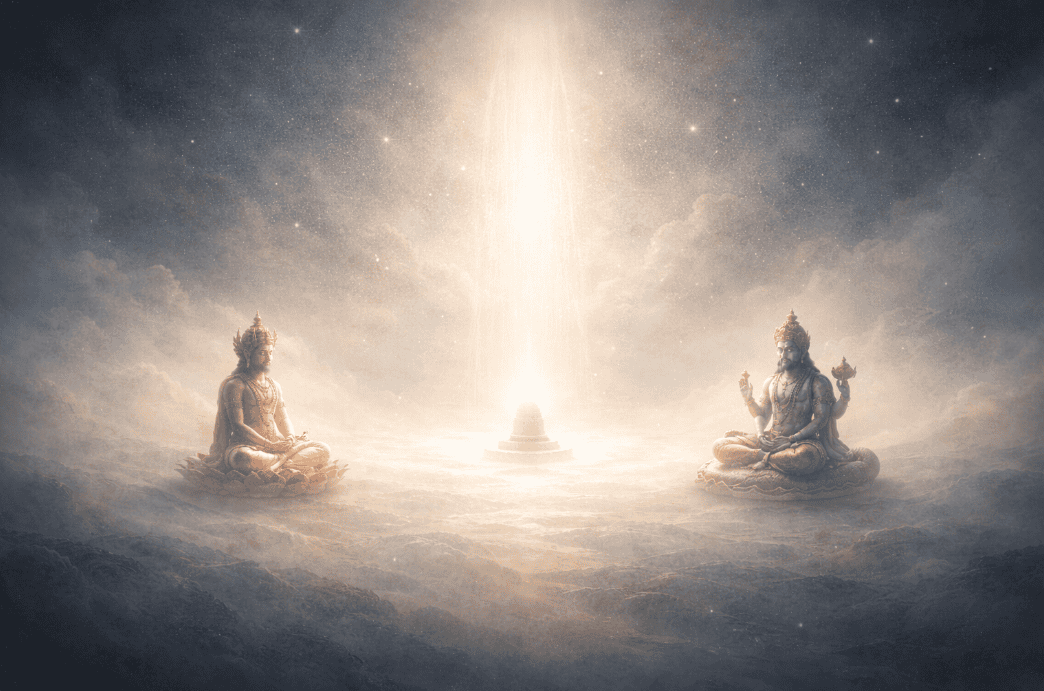
The Lingodbhava episode illustrates this resolution without relying on force.
An infinite pillar appears, not as a challenge to be conquered, but as a reality that cannot be exhausted. Effort does not overcome it. Persistence does not master it. Eventually, the question of supremacy dissolves, not through defeat, but through recognition.
What matters here is not the drama of the event, but its structure. Supremacy emerges because the finite encounters something it cannot rival.
The revelation ends conflict without declaring a victor.
Why No Punishment or War Was Required
Notably, supremacy in this narrative is not enforced. No curse is issued at this moment. No battle follows. No authority figure imposes judgment.
Once truth is revealed, enforcement becomes unnecessary. Vishnu’s acknowledgment requires no reward. Brahma’s false claim is not corrected through violence. Supremacy stands on its own.
This is a crucial distinction. Authority does not depend on fear or consequence. It depends on clarity.
Ahimsa Beyond Morality
The absence of violence in this resolution reflects a deeper principle than ethical restraint.
Ahimsa in Hindu thought is often discussed as a moral guideline. At the cosmic level, it functions as a structural necessity. Violence belongs to the realm of limitation. The infinite cannot act through harm because harm presupposes separation.
Supreme reality does not oppose. It encompasses.
This is why revelation, not confrontation, becomes the only viable mechanism. Any use of force would contradict the very nature of what is being established.
A Different Model of Authority
What emerges from this framework is a radically different model of power.
Authority does not dominate. It does not threaten. It does not require submission. It is acknowledged because it cannot be denied.
This model contrasts sharply with both mythological and human systems of power. Political authority often relies on enforcement. Religious authority often relies on command. Here, authority exists simply by being foundational.
Supremacy is not exercised. It is recognized.
Meaning Beyond Mythology
This model carries implications beyond cosmology.
It suggests that the highest form of authority does not arise from control, but from alignment with truth. It implies that conflict persists only as long as reality is misunderstood. Once understanding is complete, struggle ends naturally.
This does not eliminate action or responsibility. It reframes them. Effort operates within limits. Supremacy exists beyond them.
Why This Resolution Could Only Be Peaceful
In the end, this story could not have unfolded in any other way.
Violence would have failed to resolve the question. Silence would have left it unresolved. Revelation was the only path that could end hierarchy without creating winners and losers.
Supremacy was not asserted. It was seen.