
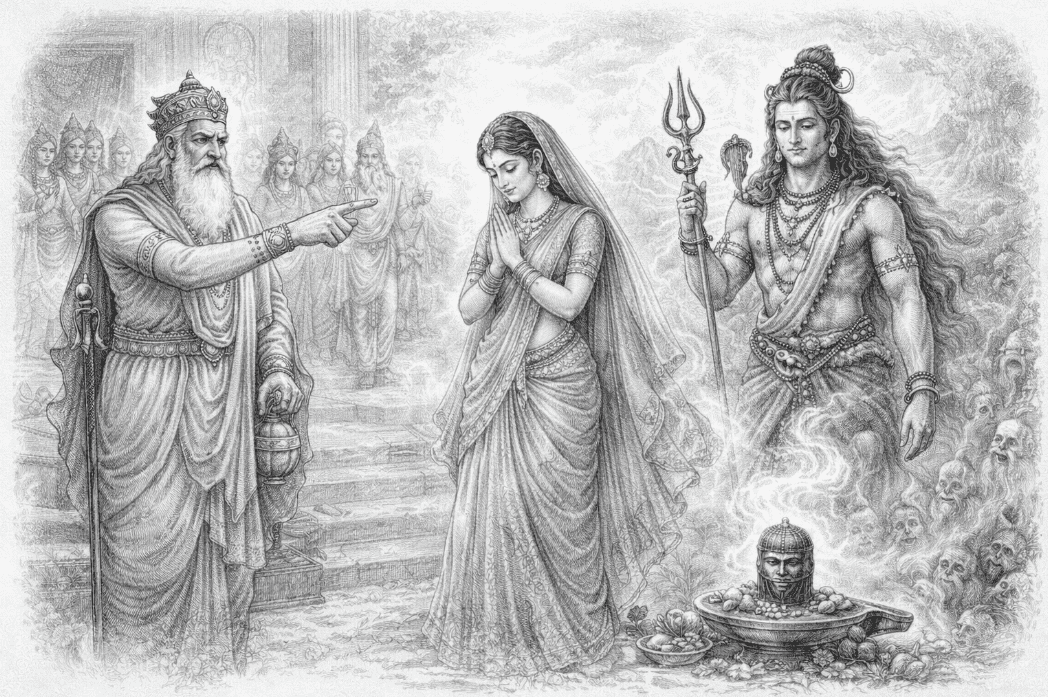
In Hindu mythology, Sati’s decision to marry Shiva is not portrayed as a sudden act of rebellion, but as the inevitable outcome of a conviction formed long before open conflict arose. As the daughter of Daksha Prajapati and an incarnation of Adi Parashakti, Sati’s orientation toward Shiva was established early, rooted in devotion rather than circumstance.
Puranic narratives describe her choice as firm and deliberate, even as her father’s resistance intensified. Her resolve reveals a tension central to the myth: ritual authority and social order on one side, and transcendence beyond convention on the other.
Article Structure
The Roots of Opposition: Daksha’s Perspective
Dakṣa, a prominent figure among the Prajapatis and son of Brahma, valued Vedic rituals, social alliances, and worldly order. He viewed Lord Shiva as an ascetic detached from societal norms, residing in mountains, smeared with ashes, adorned with serpents, and surrounded by ghosts and goblins. To Dakṣa, such a lifestyle made Shiva unsuitable as a son-in-law for his beloved youngest daughter.
Puranic accounts indicate that Daksha’s disapproval stemmed from pride and differing worldviews. He sought prestigious matches for his daughters to strengthen alliances among gods and sages. Shiva’s unconventional nature clashed with Daksha’s expectations of a groom who embodied royal dignity and ritual propriety. In some versions, such as those in the Bhagavata Purana, Daksha arranged events excluding Shiva, reflecting his growing resentment.
Despite this, Sati’s devotion remained unshaken. Her early adoration of Shiva’s tales, nurtured through narrations by sages like Narada, had already formed an unbreakable bond in her heart.
Sati’s Rejection of Other Suitors
As Sati reached marriageable age, Dakṣa explored options to secure a suitable alliance. He considered proposals from powerful kings, celestial beings, and prominent deities who aligned with his ideals of status and influence. In certain Puranic retellings, Dakṣa convened gatherings or svayamvara-like assemblies where eligible suitors presented themselves, deliberately excluding Shiva to steer Sati toward other choices.
Sati, however, consistently rejected these advances. She viewed worldly suitors as transient and lacking the depth she sought in a partner. Her heart was fixed on Shiva, whom she recognized as the supreme reality beyond material forms. Sources like the Devi Bhagavata Purana and related traditions describe how Sati politely but firmly declined offers, stating her exclusive devotion to Shiva. This rejection was not impulsive; it reflected a mature understanding that true fulfillment lay in spiritual union rather than social elevation.
In one account from the Bhagavata Purana, Dakṣa organized a svayamvara but invited all except Shiva, intending to influence her selection. Sati’s inner resolve ensured she remained unmoved, prioritizing her lifelong commitment over external pressures.
The Path of Austerity: Sati’s Tapasya to Win Shiva
Sati’s determination manifested through rigorous spiritual practices. Recognizing Shiva’s ascetic disposition and detachment, she undertook severe tapas in forests and remote areas. She fasted, meditated, and performed rituals dedicated to Shiva, enduring physical hardships to prove her sincerity.
Puranic narratives detail her isolation from comforts, living on minimal sustenance, and focusing solely on Shiva’s form. This tapas was not merely to attract him but to align her energy with his divine essence. Shiva, aware of her devotion through the intensity of her practices, eventually appeared before her. In some versions, he granted her wish directly; in others, divine intervention, such as Vishnu aiding in disguise, facilitated the marriage.
Sati’s austerities underscored her internal resolve. She sought a union based on mutual spiritual harmony, not coercion or compromise.
The Marriage: Triumph Over Opposition
Despite Dakṣa’s objections, Sati’s perseverance led to the marriage. The ceremony occurred with divine blessings, solemnized according to tradition. In certain accounts, the event took place under auspicious stars, with celestial beings in attendance. Dakṣa, though reluctant, could not prevent the union given Sati’s unwavering choice and Shiva’s acceptance.
Post-marriage, tensions persisted. Dakṣa developed deeper aversion, viewing Shiva’s presence as a challenge to his authority. Yet Sati upheld her decision with dignity, maintaining devotion to her husband while respecting familial ties where possible.
This marriage symbolized the integration of Shakti (energy) with Shiva (consciousness), a cosmic necessity fulfilled through Sati’s determination.
Internal Resolve: The Core of Sati’s Strength
Sati’s resolve stemmed from profound inner conviction. From childhood, stories of Shiva had instilled in her a sense of his supremacy and compassion. As she matured, this evolved into bhakti that transcended doubt. She understood her role in the divine plan, to draw Shiva from isolation into worldly engagement for cosmic balance.
Her strength lay in self-awareness as Adi Parashakti’s incarnation, combined with humility and purity. Rejecting suitors and defying opposition required courage born of clarity: she prioritized eternal truth over temporary familial approval.
Puranic texts portray this as exemplary devotion, where love for the divine overrides worldly attachments without resentment.
Challenges Faced and Lessons in Determination
The opposition tested Sati’s resolve. Daksha’s disapproval created emotional strain, yet she navigated it with grace. She communicated her position firmly but respectfully, avoiding confrontation until necessary.
This aspect offers lessons: determination in spiritual matters involves perseverance, ethical conduct, and inner peace. Sati’s story encourages individuals facing opposition in pursuing higher goals to remain steadfast while upholding dharma.
Her resolve also highlights autonomy in devotion. As a goddess incarnate, Sati exercised choice, affirming the feminine principle’s agency in cosmic narratives.
The Broader Cosmic Significance
Sati’s marriage to Shiva fulfilled a divine purpose. Brahma’s design, as noted in Shakta texts, aimed to unite Shakti with Shiva for creation’s continuity. Her determination ensured this union occurred on terms of mutual respect and love.
The narrative foreshadows later events, including the Dakṣa yajna, where Sati’s commitment culminated in sacrifice to defend Shiva’s honor. Her early defiance laid the groundwork for ultimate acts of devotion.
Legacy of Sati’s Determination
Sati’s story inspires devotees across Shaiva and Shakta traditions. During festivals honoring Shiva, her resolve is recalled as a model of unwavering bhakti. Temples and rituals associated with Shakti Peethas trace back to her legacy, symbolizing devotion’s transformative power.
In contemporary contexts, her narrative resonates with themes of personal conviction against societal norms, emphasizing inner strength and spiritual priority.
Conclusion: A Testament to Devoted Resolve
Sati’s defiance of her father’s will exemplifies how profound devotion can overcome formidable obstacles. By rejecting other suitors and pursuing Shiva through austerity and inner conviction, she achieved a sacred union that advanced cosmic harmony.
This account from Puranic sources reminds us that true determination arises from clarity of purpose and love for the divine. Sati’s life encourages reflection on aligning personal choices with higher truth, fostering resilience in the face of opposition.