
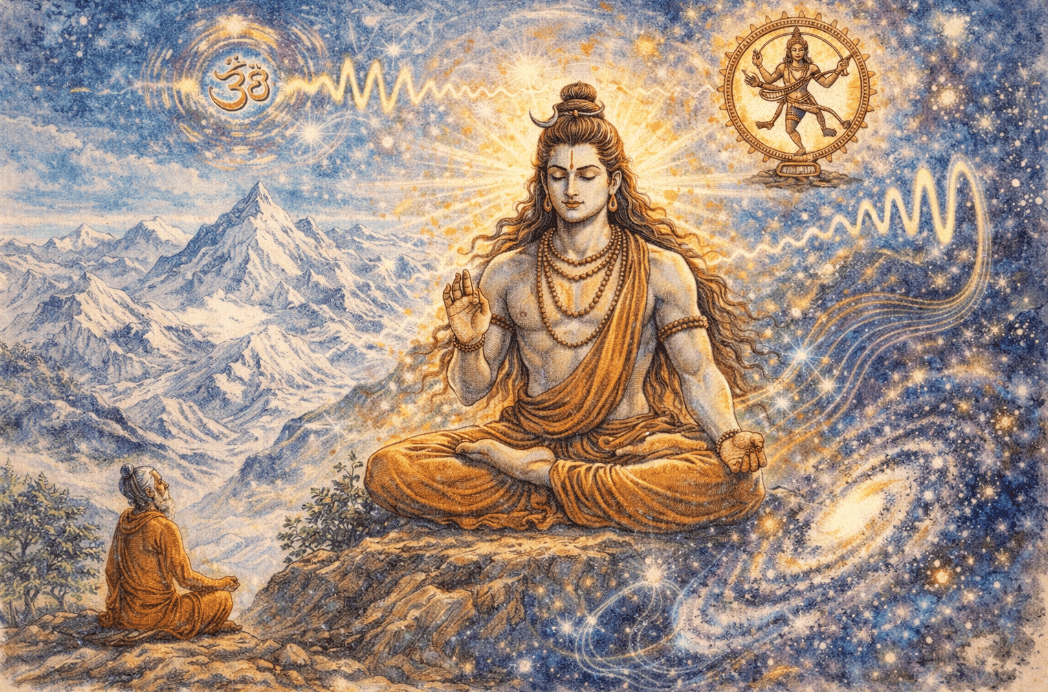
Kashmir Shaivism offers a profound vision of reality where ultimate knowledge transcends all forms of verbal expression. This tradition reveals that cosmic understanding exists independently of language, arising from the very nature of pure consciousness. In this framework, true wisdom operates beyond the veil of speech, manifesting as direct, immediate awareness of the divine essence that permeates everything.
The philosophy emphasizes that the universe is not separate from consciousness but is consciousness itself in dynamic expression. Knowledge here is not acquired through concepts or words; it is recognized as an inherent quality of being. This recognition, known as pratyabhijna, forms the core of the system. It points to a universal knowledge that is ever-present, silent, and complete, waiting only to be acknowledged.
Article Structure
The Nature of Pure Consciousness as the Source of All Knowledge
In Shaiva thought, Shiva represents pure consciousness, unchanging, infinite, and self-luminous. This consciousness is not passive; it possesses an innate capacity for self-awareness and creative manifestation. All knowledge originates from this source, existing as an undivided whole before any differentiation occurs.
The tradition teaches that ordinary knowledge relies on subject-object distinctions: a knower perceiving something known. Such dualistic cognition depends on language to label and categorize experience. Yet the highest knowledge dissolves these divisions. It is the direct apprehension of reality as it is, without mediation.
This non-dual awareness is described as svatantrya, absolute freedom. Consciousness knows itself perfectly and spontaneously, without effort or external reference. In this state, knowledge is not something added to the self; it is the self in its essential nature. Words become unnecessary because the truth is self-evident and self-revealing.
Pratyabhijna: The Recognition That Unveils Eternal Truth
The doctrine of pratyabhijna, developed by masters such as Utpaladeva and Abhinavagupta, provides the key to accessing this non-verbal knowledge. Pratyabhijna means “recognition” or “re-cognition”, the sudden realization that the individual self is identical with the supreme consciousness.
This recognition does not involve learning new information. Instead, it removes the veil of forgetfulness (maya) that creates the illusion of separation. When the limited sense of “I” falls away, what remains is the pure “I” of Shiva, self-aware, all-encompassing, and free from limitation.
The process is described as an inner awakening triggered by grace (anugraha). Grace operates beyond intellectual effort, often through subtle inner vibration or the presence of a realized teacher. Once recognition occurs, the practitioner sees the entire universe as an expression of this same consciousness. Knowledge then becomes universal, not personal or conceptual.
The Subtle Vibration of Spanda as the Bridge to Awareness
A central concept in this system is spanda, the divine pulsation or throb inherent in consciousness. Spanda is the spontaneous movement through which the absolute manifests diversity while remaining undivided. It serves as the subtle mechanism by which non-verbal knowledge becomes accessible.
This vibration is not physical sound but an inner dynamism felt in deep contemplation. When the mind becomes still, the practitioner experiences spanda as the living presence of consciousness. Through attunement to this pulsation, one moves beyond thought and language into direct participation in cosmic reality.
Spanda thus functions as a bridge: it connects the manifest world to the unmanifest source without relying on verbal constructs. The experience is immediate and holistic, conveying knowledge through felt resonance rather than explanation.
Shiva Nataraja: The Cosmic Dance as Expression of Universal Knowledge
The form of Shiva as Nataraja, the Lord of the Dance, beautifully encapsulates these insights. In this iconic representation, Shiva performs the tandava, the cosmic dance that sustains, transforms, and dissolves the universe. Every gesture and posture symbolizes aspects of reality without words.
The raised foot signifies liberation, the drum in one hand produces the rhythm of creation, and the circle of fire represents the cycle of existence. Yet the dance itself is silent in its deepest meaning; it communicates the totality of cosmic knowledge through movement and presence.
Nataraja embodies the paradox: infinite activity arising from perfect stillness. The dancer remains centered while the world whirls around him, illustrating how non-verbal knowledge encompasses both transcendence and immanence.
Practical Implications for Contemporary Seekers
The Shaiva insights into non-verbal cosmic knowledge hold significant relevance today. In a world dominated by information and verbal discourse, this tradition offers a path of return to direct experience. Practices such as silent meditation, contemplation of inner vibration, and cultivation of surrender facilitate the recognition of one’s true nature.
The approach is inclusive: it requires no specialized terminology or external authority. Any individual can turn inward, quiet the mind, and allow the inherent awareness to emerge. Over time, this leads to a transformed perception where daily life becomes an expression of divine consciousness.
The tradition also addresses the limitations of language in spiritual matters. Words can point toward truth but cannot contain it. By moving beyond speech, one discovers a knowledge that is certain, liberating, and universal.
Embracing the Silent Source of All Knowing
Shaiva philosophy ultimately invites recognition of the cosmic knowledge that exists beyond the veil of speech. It reveals a reality where consciousness knows itself perfectly, without division or mediation. Through pratyabhijna, spanda, and symbolic forms such as Nataraja, this knowledge becomes accessible as lived experience.
In this non-verbal domain lies the essence of true freedom and understanding. The journey requires only openness and stillness, an invitation to rest in the eternal awareness that has always been present. By honoring this silent source, one participates fully in the mystery and beauty of existence.