
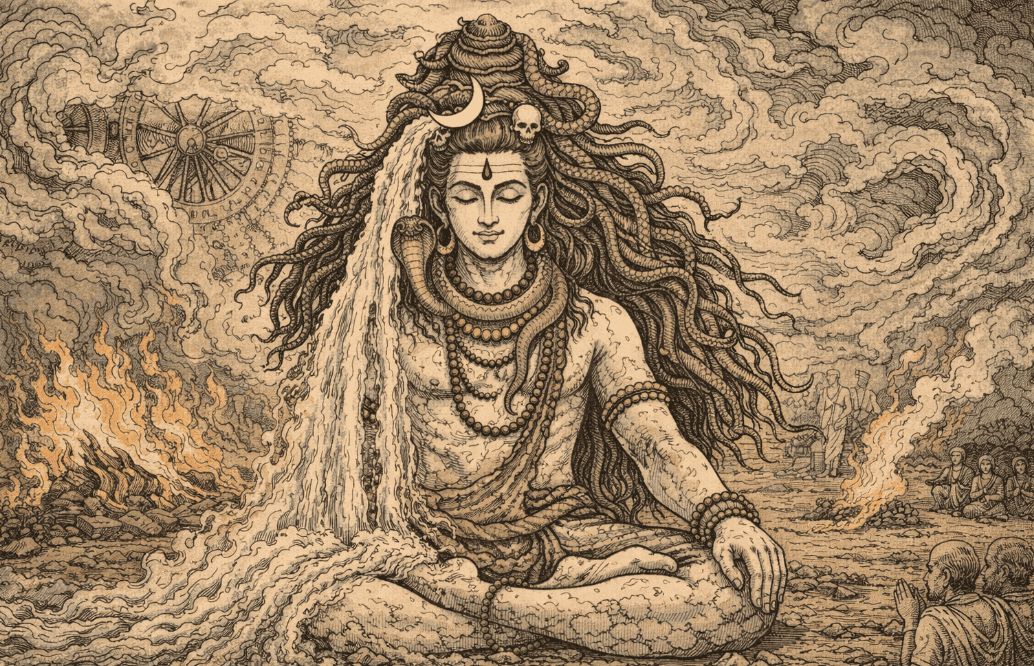
Among Lord Shiva’s distinctive features, the matted locks known as jata (or jatamukuta when piled high like a crown) stand out prominently. These tangled strands flow freely or coil atop his head, holding within them the crescent moon, serpents, and most famously, the river Ganga.
Far from indicating neglect, Shiva’s jata represents containment, restraint, and mastery. They hold forces that, if released unchecked, could destabilize creation itself. At the same time, they express his complete detachment from vanity and social norms. Drawing from Puranic narratives, epic literature, and Shaiva philosophy, this article examines what Shiva’s matted locks truly contain and why their restraint is central to his cosmic role.
Article Structure
The Myth of the Descent of the Ganga: Containing Cosmic Fury
The most celebrated story associated with Shiva’s jata involves the descent of the sacred river Ganga (Ganges) from the heavens to Earth. According to narratives in the Ramayana (Bala Kanda), Mahabharata, and Shiva Purana, King Bhagiratha performed severe penance to bring the heavenly Ganga down to purify the ashes of his ancestors and grant them liberation.
When Ganga was released from her celestial abode (often linked to the Milky Way), her torrential force threatened to flood and destroy the Earth. The river’s descent carried immense destructive power, capable of shattering mountains and submerging worlds. Bhagiratha appealed to Shiva for protection. Shiva agreed and positioned himself beneath the falling waters.
He caught the mighty Ganga in his matted locks. The tangled strands absorbed the river’s violent momentum, taming its fury into a gentle stream that flowed safely to Earth. This act earned Shiva the epithet Gangadhara (Bearer of the Ganga). The water trickles from his jata in artistic depictions, symbolizing controlled divine grace rather than chaos.
This narrative illustrates the jata as a cosmic container. The locks function like a natural dam or reservoir, holding back overwhelming energy. Without Shiva’s intervention, the Ganga’s force would have caused devastation; his matted hair restrains it, channeling purification and life-giving flow instead. Philosophically, this reflects Shiva’s capacity to balance destruction and benevolence, containing forces that could annihilate yet allowing them to nourish when properly directed.
Mastery Over Unbound Energies: Wind, Primal Chaos, and Cosmic Forces
Beyond the Ganga, Shiva’s jata restrains other elemental and cosmic powers. In yogic and Shaiva traditions, the locks symbolize control over vayu (wind or air), one of the five primal elements. Wind represents movement, breath, and life force (prana), but unbound it becomes chaotic turbulence. Shiva’s tangled hair contains this energy, preventing it from dispersing wildly.
Some interpretations link the jata to the storage of spiritual energy accumulated through intense meditation. As the supreme yogi (Adiyogi), Shiva generates vast tapas (austerity-generated power) during deep contemplation. His matted locks act as a reservoir for this shakti, preventing it from overwhelming the universe. If released unchecked, such energy could disrupt cosmic order; the jata restrains it, maintaining equilibrium.
In broader symbolism, the jata embodies mastery over primal chaos, the formless, unbound state preceding creation. Shiva, as the destroyer, dissolves forms into chaos for renewal. His tangled hair visually represents this controlled chaos: strands intertwine without order yet remain contained, mirroring how he harnesses destructive potential for transformative purposes.
Certain texts describe the jata as wound in three coils, signifying mastery over iccha shakti (will), jnana shakti (knowledge), and kriya shakti (action), the three fundamental powers underlying existence. These forces, if uncontrolled, lead to imbalance; Shiva’s locks bind them harmoniously.
The jata also restrains time itself in some views. Wound around the head, it symbolizes transcendence over past, present, and future, containing temporal cycles within an eternal framework.
Detachment from Vanity: Rejecting Societal Norms of Beauty
Shiva’s refusal to comb or style his hair underscores profound detachment from vanity and ego. In ancient Indian society, well-groomed hair signified beauty, social status, and care for appearance. Ascetics, however, often allowed hair to mat as a sign of renunciation.
Shiva’s jata exemplifies this rejection. He disregards conventional grooming, focusing solely on inner realization. The unkempt appearance contrasts with adorned deities, emphasizing that true divinity transcends physical aesthetics. By allowing his hair to tangle naturally, Shiva demonstrates indifference to worldly judgments and sensory pleasures.
This detachment extends to ego dissolution. Grooming reflects attachment to self-image; matted locks signify freedom from such concerns. Devotees interpret this as an invitation to prioritize spiritual growth over external validation.
In yogic physiology, long, matted hair is believed to aid energy retention. Strands act like antennas for cosmic prana, enhancing meditation. Shiva’s jata thus serves dual purposes: practical for yogic power and symbolic for renunciation.
Artistic and Scriptural Depictions
Iconography consistently portrays Shiva’s jata as voluminous and dynamic. In Nataraja form, locks spread outward during the cosmic dance (Tandava), conveying vigorous yet controlled movement. Serpents often entwine the strands, reinforcing restraint over fear and poison (kundalini-like energies).
The Shiva Purana and related texts describe Shiva as Jatadhara (bearer of matted hair) and Kapardin (one with coiled locks). These epithets highlight the jata’s centrality. Artistic traditions across regions vary slightly, some show flowing locks, others piled high, but the theme of containment remains constant.
Shiva’s Matted Locks – Lessons for the Seeker
Shiva’s jata offers guidance for seekers. It teaches control over inner forces: desires, emotions, and thoughts that, if unchecked, create personal chaos. By “matting” these through discipline, one channels them constructively.
The symbol encourages detachment from superficial concerns. In a world emphasizing appearance, Shiva’s locks remind us that genuine power arises from inner mastery, not external polish.
For yogis, the jata inspires practices that build and contain energy, pranayama, meditation, and austerity, without dissipation.
Ultimately, it affirms Shiva’s role as cosmic stabilizer: containing forces of nature, time, and energy to sustain universal harmony.
Shaiva Interpretations of Shiva’s Jata
Shiva’s matted locks are not an incidental ascetic feature. They are a symbolic vessel that contains destructive forces, spiritual energy, and cosmic movement itself. From restraining the descent of the Ganga to embodying controlled chaos and renunciation, the jata reveals Shiva’s unique role as cosmic stabilizer.
They also express profound detachment from ego and appearance, reinforcing the Shaiva path of inner mastery over outer control. Through myth and symbol, Shiva’s jata teaches that true strength lies not in unchecked force or refinement, but in restraint guided by awareness.
Within these tangled locks lies a quiet truth: liberation emerges when power is held with discipline, and freedom arises when ego is allowed to dissolve.