
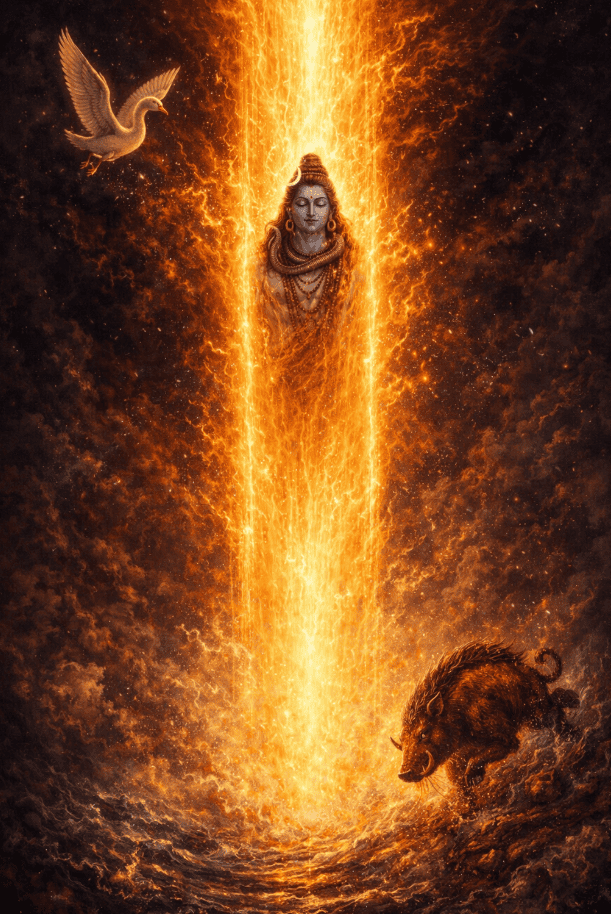
In Hindu beliefs, Lord Shiva holds a special place as the one who existed before everything else. He is seen as the original source from which the other two main gods, Brahma, who creates the universe, and Vishnu, who protects it, come into being. This idea shows Shiva’s top position in the order of gods, known as the Trimurti. While many people think of Brahma, Vishnu, and Shiva as equal partners in running the world, traditions that focus on Shiva, called Shaivism, teach that Shiva is the supreme being. Brahma and Vishnu arise from him to do their jobs of creation and protection. This post explains this concept in simple terms, using stories from ancient texts, meanings of symbols, and ideas from Shaiva philosophy.
Article Structure
The Trimurti and Shiva’s Higher Place
The Trimurti means “three forms” and refers to Brahma the creator, Vishnu the preserver, and Shiva the destroyer who also transforms. In some Hindu views, these three are equal and share the work of the universe. But in Shaivism, Shiva is the highest god, and the others are parts of his power. Ancient books like the Shiva Purana and Linga Purana say Shiva is the eternal one who gives rise to Brahma and Vishnu when it is time for a new universe.
This does not mean Brahma and Vishnu are less important in their roles. They handle creation and protection, but they come from Shiva and return to him at the end of a cosmic cycle. Shiva stays beyond these changes, as the main source.
The Famous Story of the Infinite Pillar of Fire
One of the best-known stories that shows Shiva’s priority is the Lingodbhava tale, found in the Shiva Purana and other texts. At the start of creation, Brahma and Vishnu argued about who was greater. Brahma said he was the creator, so he was supreme. Vishnu said he protected everything, so he was the top god.
To settle the fight, a huge pillar of fire appeared between them. It had no beginning or end, it stretched infinitely up and down. Brahma turned into a swan and flew upward to find the top. Vishnu became a boar and dug downward to find the bottom. They searched for thousands of years but could not find either end.
Finally, they gave up and bowed to the pillar. From it, Shiva appeared as a lingam, the symbol of his formless power. He told them that he was the source of both, without beginning or end. Brahma and Vishnu accepted this and praised Shiva as the greatest.
This story teaches that Shiva existed before Brahma and Vishnu even started their search. The infinite lingam represents Shiva’s timeless nature. Many temples have sculptures of this scene, with Shiva emerging from the lingam, Brahma as a swan above, and Vishnu as a boar below.
Other Stories from Ancient Texts
Several Puranas tell how Brahma and Vishnu come from Shiva. In the Shiva Purana, at the beginning of creation, Shiva is alone in his supreme form, called Sadashiva. From his will, a lotus grows, and Brahma is born on it from Shiva’s navel or energy. Similarly, Vishnu appears as part of Shiva’s plan to maintain the world.
In some versions, Vishnu rests on the cosmic ocean, and from his navel comes a lotus with Brahma. But Shaiva texts say that this Vishnu is a form created by Shiva, and the real source is Shiva himself.
Another tale describes Shiva as Ardhanarishvara, half male and half female. This form shows Shiva’s complete nature, combining his consciousness with Shakti, his power. From this union, the process of creation starts, leading to Brahma and Vishnu.
These stories make it clear that Shiva is primordial, he exists first, and the others emerge from him.
What Shaiva Teachings Say
Shaivism has different branches, but most agree Shiva is the ultimate reality. In Kashmir Shaivism, a non-dual school, Shiva is pure consciousness. Everything, including Brahma and Vishnu, is an expression of his power. Texts like the Tantraloka by Abhinavagupta explain that Shiva is beyond time, and creation happens through his free will.
In Shaiva Siddhanta, Shiva is the lord who creates souls and the world. Brahma and Vishnu are like helpers who carry out specific tasks under Shiva’s direction.
Even in the Vedas and Upanishads, early hints point to one supreme being, often linked to Rudra-Shiva in later views. The Svetashvatara Upanishad calls this being the ruler of all, from whom creation arises.
Symbols That Show Shiva’s Priority
Art and temple symbols also highlight this idea. The Shiva Lingam is the main sign of Shiva, representing endless potential. In the Lingodbhava images, it proves Shiva has no limits, unlike Brahma and Vishnu.
Sadashiva forms, with five faces, show Shiva as the source of the five cosmic acts: creation, preservation, destruction, concealment, and grace. Brahma handles creation, Vishnu preservation, but all come from Shiva.
In many Shiva temples, like those with Jyotirlingas, the focus is on Shiva as the eternal light.
Why This Matters in Spiritual Life
Understanding Shiva as primordial helps devotees see him as the ultimate refuge. It teaches that beyond the changing world managed by Brahma and Vishnu, Shiva is the unchanging truth. Worshipping Shiva can lead to freedom from rebirth, as he grants grace.
This view also promotes harmony among Hindu traditions. While Shaivas see Shiva as supreme, they respect Brahma and Vishnu as important aspects.
In daily practice, mantras like “Om Namah Shivaya” connect people to this original Shiva.
Differences with Other Views
In Vaishnavism, Vishnu is the supreme, and Shiva and Brahma come from him. In some general Hindu views, all three are equal. But Shaiva texts argue their case with stories and logic, showing Shiva’s priority.
These differences enrich Hinduism, allowing various paths to the divine.
Conclusion: Shiva as the First and Eternal Source
The idea of Shiva’s primordial existence places him before Brahma and Vishnu in time and importance. He is the source from which creation and preservation flow. Stories like the infinite pillar, teachings from Puranas, and symbols in art all support this. This makes Shiva not just a destroyer but the complete supreme being.
As we continue exploring Shiva’s nature, this priority leads naturally to his formless state before any manifestation.