
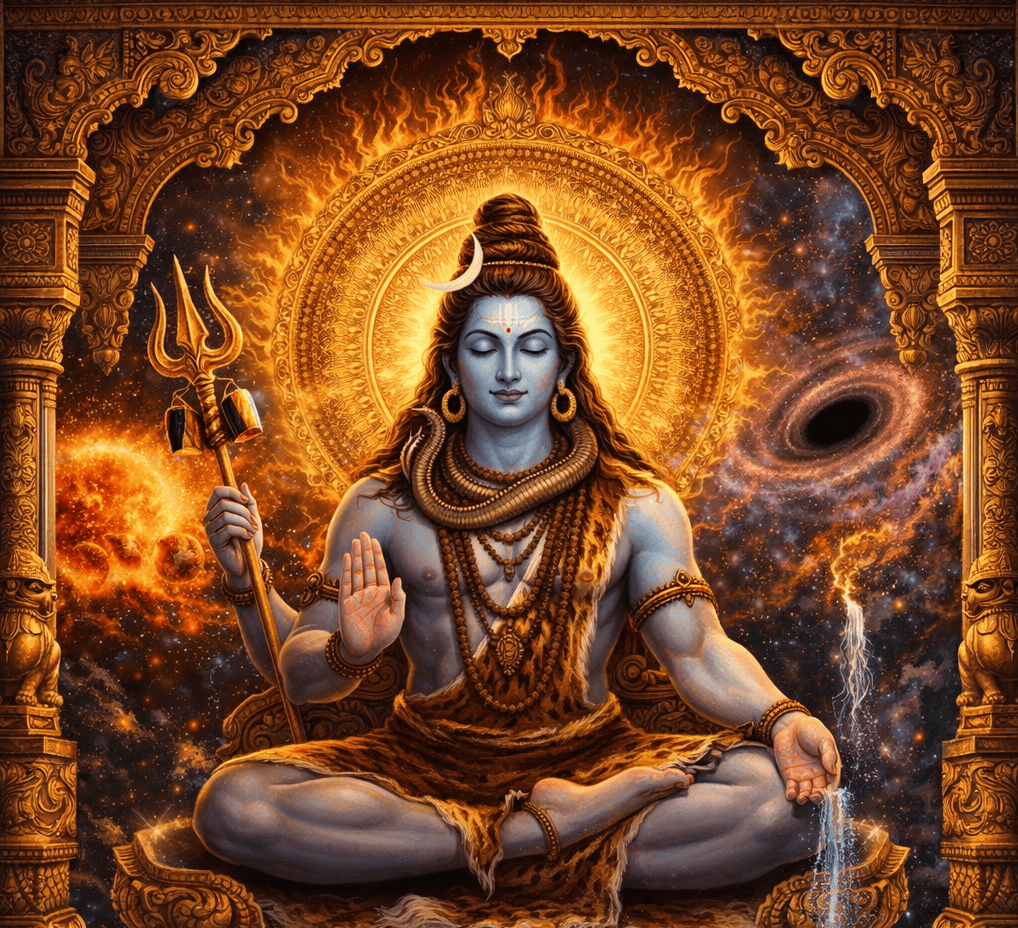
In the profound and multifaceted framework of Hindu metaphysical traditions, Lord Shiva is universally acknowledged as the quintessential representation of eternal permanence and absolute unchangeability. He exists wholly beyond the endless alternations between cosmic creation, designated as Srishti, and cosmic dissolution, known as saṃhara, manifesting an immutable essence that defies origination, alteration, or cessation. This detailed examination seeks to elucidate the core rationales underpinning Shiva’s eternal and unaffected status, effectively merging considerations of his enduring existence outside the domain of manifestation with his calm, unaltered continuity during and in the aftermath of Mahapralaya, the monumental great dissolution encompassing the entirety of the cosmos. Anchored solidly in canonical Shaiva textual resources, including the comprehensive Shiva Purana, the esoteric Linga Purana, the venerable SvetaSvatara Upanishad, and the refined non-dualistic elucidations characteristic of Kashmir Shaivism, this discourse clarifies Shiva’s exalted role as the supreme foundational reality, ParamaSiva. His eternity transcends conventional temporality, embodying instead the pristine pure consciousness (cit-Sakti) that constitutes the steadfast bedrock for all possible phenomena, all the while preserving total detachment from their ephemeral variations and evolutions.
Article Structure
Exploring the Essence of ParamaSiva: Transcendence Surpassing All Forms of Duality
The pivotal foundation for understanding Shiva’s eternal attribute lies in identifying him as ParamaSiva, the paramount reality stripped of any qualifying attributes, positioned far above every conceivable dichotomy of existence versus non-existence or change versus stasis. Shaiva systematic theology meticulously differentiates the nirguṇa dimension, utterly devoid of qualities, from the saguṇa dimension, which incorporates attributes and actively participates in cosmic operations. The nirguṇa ParamaSiva, by contrast, endures in perpetual liberation from the sequential phases of emergence, modification, decline, and termination that define limited, conditioned realities.
Among the earliest and most authoritative endorsements of this principle is found in the SvetaSvatara Upanishad (specifically verses 4.18-21 and 6.1-2), which eloquently declares: “He is the sole divine entity concealed within every being, omnipresent yet profoundly subtle… lacking any inception, intermediary stage, or conclusion… the perpetual one, permeating the totality of existence, immovable and eternally stable.” These pronouncements unequivocally designate Shiva as akṣara, the fundamentally indestructible principle immune to the chronological and causal forces governing the phenomenal universe. Creation materializes through the harmonious interplay of Shiva with his indwelling dynamic potency, Sakti, without entailing any depletion, distortion, or transformation of his intrinsic core. Dissolution, on the other hand, entails the systematic withdrawal of all emanated forms back into their primordial source, yet Shiva remains entirely uninvolved and unmodified, he serves exclusively as the timeless observer (saksi) who beholds occurrences without immersion or consequence.
This transcendent attribute is most prominently displayed within the framework of Mahapralaya. As the complete observable universe, encompassing gross and subtle elements, myriad lokas or worlds, hierarchical deities, and countless individual souls, undergoes exhaustive reabsorption into a homogeneous state of primordial balance, ParamaSiva resides undisturbed in his original, unadulterated condition. The mechanics of dissolution simply retract the veneer of multiplicity and diversity; they exert no influence whatsoever upon the underlying substratum, which persists in perpetual plenitude (purṇa) and intrinsic self-sufficiency, requiring nothing external for its sustenance or definition.
Shiva’s Immutable Permanence – Puranic Mythological Accounts
The rich tapestry of Puranic compositions furnishes a wealth of mythological narratives that compellingly exemplify Shiva’s unchanging eternal nature. Within the Shiva Purana, notably in the VidyeSvara Samhita and Rudra Samhita portions, Shiva is recurrently presented as SadaSiva, the invariably auspicious manifestation that antedates the very emergence of temporal frameworks, spatial extensions, and causal interconnections. A particularly striking narrative is the Lingodbhava episode: arising from a rivalry between Brahma and Vishnu concerning ultimate sovereignty, Shiva reveals himself as an interminable columnar shaft of effulgent light. Brahma, metamorphosing into a swan, strives upward to locate its crown, while Vishnu, adopting the guise of a boar, probes downward for its root, both quests end in failure. This allegorical event powerfully conveys Shiva’s complete absence of commencement or termination, affirming him as the illimitable essence that both predates and perpetuates beyond every architectural configuration within the cosmic order.
In relation to Mahapralaya, the Linga Purana (first division, chapters 70 to 75) furnishes an elaborate depiction of the phased deconstruction: gross elemental forces assimilate into subtler counterparts, subtle ontological categories retract into the primordial matrix of prakṛti, and prakṛti subsequently resolves into the unmanifest potentiality. Brahma exhausts his prescribed longevity and subsumes into the supreme absolute. Nonetheless, Shiva, appearing in his formidable Rudra guise, orchestrates and executes this all-encompassing dissolution by means of his grandiose cosmic dance, the Tandava, without incurring any personal mutation or perturbation. The Purana explicitly avers: “Following the complete retraction of the universe into my essential being, I endure as the solitary reality devoid of any second, immutable and infinitely eternal.” Consequently, the phenomenon of dissolution emerges as a deliberate volitional expression originating from Shiva rather than as an imposed external agency capable of impacting him.
Texts oriented toward Vaishnava perspectives, such as the Bhagavata Purana (third skandha or canto), offer indirect corroboration of Shiva’s overarching transcendence. Though Vishnu assumes a state of yogic slumber during pralaya to conserve the latent potential for subsequent creations, interpretive commentaries from Shaiva scholars position this slumber as subsumed within the broader expanse of Shiva’s consciousness, wherein Shiva persists as the definitive unaffected foundational principle.
The Non-Dualistic Paradigm of Kashmir Shaivism: Conceptualizing Eternity as Pristine Pure Consciousness
Kashmir Shaivism delivers arguably the most elaborate and logically coherent philosophical scaffolding for grasping Shiva’s impervious eternal quality. This school delineates reality through a schema of thirty-six tattvas or constitutive principles, beginning with Siva-tattva, symbolizing undifferentiated, pure consciousness, and immediately succeeded by Sakti-tattva, the activating force of projection and expression. The ensuing tattvas signify incremental degrees of constriction and delimitation, eventuating in the experiential multiplicity characteristic of the material realm.
As masterfully expounded by Abhinavagupta in seminal treatises like the Tantraloka and the iSvarapratyabhijna-vimarSini, the manifested universe constitutes a spontaneous outward expression (svatantrya) deriving from Shiva’s innate volitional freedom. Creation and dissolution, therefore, represent nothing more than intrinsic oscillatory vibrations (spanda) transpiring within the domain of consciousness, as opposed to extrinsic happenings with the capacity to modify its essential character. Throughout Mahapralaya, the tattvas undergo orderly retraction in inverted succession, ultimately reconverging upon Siva-tattva. This reconvergence does not impoverish or attenuate Shiva; rather, it unveils his congenital completeness and wholeness (purṇatva). An instructive passage from the Vijnana Bhairava Tantra (verse 138) advises: “In the instant of cosmic dissolution, directly apprehend your fundamental identity with the unending luminescence of consciousness itself.”
Additionally, the core tenet of pratyabhijna, translated as recognition or re-cognition, illuminates how the evolutionary path of the bounded individual soul replicates macrocosmic patterns: spiritual constriction arises from amnesia concerning one’s inherent oneness with Shiva, while ultimate release stems from the recovery of that awareness. Accordingly, Shiva’s eternity is not an abstracted or remote property but the proximate substance of the innermost self (atman), constantly accessible and wholly resistant to superficial perturbations or apparent transformations.
Shiva’s Profound Detachment Across Expansive Cosmic Chronologies: Functioning as the Timeless Observer
The scope of Shiva’s exemption from cosmic influence encompasses the grandiose temporal divisions delineated in classical Hindu cosmology, comprising kalpas (equivalent to Brahma’s diurnal periods), manvantaras (extended epochs under specific progenitors), and yugas (subdivided ages within cycles), each punctuated by corresponding partial dissolutions. Throughout these vast durations, Shiva sustains his status as nitya (intrinsically perpetual) and fundamentally niṣkriya (beyond compulsory action), despite occasional apparent involvement in manifest functionalities. The monumental epic Mahabharata, within its Anushasana Parva (specifically chapter 145), vividly depicts Shiva immersed in deep contemplative absorption atop the sacred Mount Kailash, entirely impervious to the dramatic cosmic unfoldments encircling him.
In the context of Shaiva Siddhanta, a tradition emphasizing a qualified dualism, Shiva operates as the authoritative pati or sovereign master who extends transformative grace (anugraha) to encumbered souls (paSu) precisely during phases of dissolution, thereby advancing their progressive emancipation without any encroachment upon his inherent aloofness and serenity. His defining attribute of svatantra, signifying unqualified autonomy and independence, sharply differentiates him from all sentient beings constrained by the mechanisms of karma, rebirth, and the veiling power of maya.
Symbolic Elements That Underscore Shiva’s Eternal Transcendence
Conventional representations in Shiva iconography uniformly communicate his transcendent permanence across cycles. The Sivalinga emblemizes the amorphous, infinite absolute, capable of assimilating boundless potentiality during pralaya intervals while itself persisting timelessly without form or limitation. The integrated Ardhanarishvara configuration portrays the unbreakable fusion of passive consciousness and active energy, wherein neither polarity exerts dominance or causes diminution in the unified whole. Within the celebrated Nataraja archetype, the circumferential band of flames encapsulates recurrent cosmic processes, juxtaposed against Shiva’s composed facial demeanor and uplifted limb, collectively denoting emancipation that surpasses and overrides those very processes.
Venerable architectural sites, illustrated by the renowned Chidambaram temple complex housing its distinctive akaSa linga (representing ethereal space), accentuate Shiva’s boundless and formless perpetuity, rendered discernible exclusively through the medium of spiritually attuned perception.
Extensive Philosophical, Spiritual, and Contemporary Implications of Shiva’s Eternal Nature
Deliberate contemplation of Shiva’s eternal disposition engender profound detachment (vairagya) coupled with rigorous self-examination regarding the ultimate nature of existence. Well-established devotional methodologies, prominently featuring the rhythmic chanting of the sacred Pancakṣara mantra (“Om Namah Shivaya”), are purposefully structured to erode entrenched egoic constructs and enable direct experiential congruence with the immutable inner core. Philosophically, this teaching directly confronts pervasive human anxieties surrounding transitoriness and finitude: acknowledging that even the grand cosmic edifice periodically dissolves, the exemplar provided by Shiva instills confidence in the invariable endurance of a fundamental, unchanging stratum beneath all appearances.
Within modern scholarly and scientific dialogues, Shiva’s paradigm of eternity exhibits striking correspondences with sophisticated cosmological hypotheses advocating oscillatory universes, wherein a durable underlying substrate, whether quantum vacuum or informational matrix, survives successive phases of inflationary expansion and gravitational contraction.
Shiva as the Unshakable Nucleus of Ultimate Reality
The eternal and unaffected disposition of Lord Shiva in relation to the dual processes of creation and dissolution represents the bedrock principle of genuine Shaiva doctrinal wisdom. Manifesting as ParamaShiva, he dwells as the undifferentiated expanse of pure consciousness, effortlessly surpassing the comprehensive absorptive operations of Mahapralaya whilst concurrently acting as the perpetual observer and primordial wellspring of all conceivable realities. Synthesized from an array of sacred scriptural testimonies, intricate philosophical architectures, and evocative symbolic expressions, this profound realization affords not merely conceptual lucidity but also a practicable pathway toward cultivating profound inner equilibrium amidst the inexorable vicissitudes inherent in universal manifestation.
This consolidated comprehension logically transitions toward deeper investigations into Shiva’s primordial ontological precedence preceding the manifestation of subordinate divine entities within the cosmic hierarchy.